
Stepping beyond the familiar borders of our own countries presents an extraordinary opportunity to learn, grow, and connect. However, modern global mobility carries a profound responsibility. Navigating diverse environments requires much more than simply packing a bag; it demands a deep commitment to cultural preservation and mindful interaction. When we cross borders, we are not merely observers of a landscape, but active participants in delicate, living human ecosystems.
Currently, the paradigm of exploration is shifting from passive sightseeing to active, ethical engagement. Visitors are increasingly seeking ways to minimise their footprint while maximising their positive impact on host communities. This transition involves understanding complex social dynamics, from the economic realities of rural craft makers to the unwritten rules of non-verbal communication. Grasping these concepts is what separates a transient tourist from a respectful global guest.
This comprehensive resource unpacks the fundamental pillars of responsible global interaction. Whether you are navigating severe language barriers in a bustling market, considering how to support local artisans, or hoping to witness sacred rituals without causing offense, understanding these underlying dynamics will fundamentally transform the way you experience the world.
Entering a remote global community is akin to being invited into someone’s private sanctuary. It is a privilege that requires immense tact and a willingness to de-centre our own expectations. Indigenous cultural heritage is often deeply tied to specific lands, ancestral histories, and delicate social structures that can be easily disrupted by well-meaning but uneducated visitors.
One of the primary dilemmas visitors face is deciding how to approach sensitive areas. The choice between guided group tours and solo visits carries significant weight. While solo visits might feel more authentic and adventurous, they often lack the crucial contextual moderation that an indigenous-led guide provides. Indigenous guides act as cultural bridges, ensuring that visitors do not inadvertently cross invisible boundaries.
There is a profound difference between observing a sacred ritual and intruding upon it. Visitors are sometimes invited to participate in local ceremonies, but doing so requires strict adherence to local customs. Treating a sacred event as a simple photo opportunity strips it of its spiritual significance and deeply offends those who hold it dear.
The souvenirs we choose to bring home represent a direct economic vote. Currently, global markets are flooded with cheap, factory-made imitations of traditional crafts. This commodification not only dilutes cultural heritage but also actively threatens the financial stability of authentic rural craft makers who rely on their skills for survival.
Purchasing mass-produced items is comparable to supporting fast fashion over local tailoring; it prioritises convenience over ethical economic practices. When visitors buy these cheap replicas, the money rarely reaches the community that originated the design. Instead, it funnels into large-scale manufacturing systems, actively undercutting the artisans who spend weeks or months creating a single authentic piece.
To truly respect native customs and empower communities, it is essential to bypass intermediary charities or commercial vendors whenever possible. Engaging directly with the makers fosters mutual respect and ensures that the financial benefits of tourism stay within the local economy.
Language is the most obvious barrier to meaningful cross-cultural interactions, yet it is often the most misunderstood. Many travelers assume that without shared vocabulary, deep human connection is impossible. However, building mutual understanding relies less on perfect grammar and more on genuine effort, vulnerability, and active listening.
In recent decades, the reliance on translation applications has skyrocketed. While these tools are excellent for logistical tasks, such as finding a bus station or checking hotel prices, relying exclusively on them prevents genuine human connection. Staring at a screen inherently breaks eye contact and interrupts the natural rhythm of empathy. Technology facilitates the transaction of information, but it completely strips away the emotional resonance of a shared struggle to understand one another.
For those living abroad as expats or staying in local communities for extended periods, choosing the right environment for interaction is key. There is often a debate between formal language exchanges and informal homestay dinners. Homestay dinners naturally cultivate deeper friendships because they revolve around the universal, intimate act of breaking bread together, creating a safe space for vulnerability and shared laughter over inevitable linguistic mistakes.
You do not need to be fluent to show profound respect. Learning a targeted set of vocabulary can drastically alter how you are perceived by locals. The goal is to memorise essential phrases that demonstrate humility and an eagerness to learn.
Communication extends far beyond spoken words. In many cultures, non-verbal cues carry more weight than verbal declarations. A casual gesture that is entirely benign in your home country might trigger immediate hostility elsewhere. Understanding these silent vocabularies is a critical component of respectful local engagement.
Physical space, hand gestures, and eye contact are interpreted radically differently across the globe. For example, pointing with an index finger, a common habit in the West, is considered highly aggressive in many parts of Southeast Asia. Similarly, touching someone’s head can be deeply offensive in regions where the head is viewed as the sacred highest point of the body. Success in rural markets or rural dining often relies heavily on mimicking the local pace, lowering one’s voice, and using culturally appropriate hand signals to order food or negotiate.
The camera lens is perhaps the most dangerous tool a visitor carries. A profound photography error that deeply offends local tribal elders is the assumption that public space equals public domain. Capturing images of people without their consent reduces them to mere scenery rather than human beings.
Ultimately, becoming a responsible participant in our global community is an ongoing journey of education and humility. By prioritising direct economic support, embracing the vulnerability of language barriers, and deeply respecting sacred cultural boundaries, we can transform simple trips into profoundly meaningful cross-cultural exchanges. True exploration is not about what we take away from a destination, but the respect and integrity we leave behind.

Contrary to popular belief, the key to connecting across severe language gaps isn’t mastering translation apps. In fact, over-relying on them can prevent genuine bonds. This guide reveals that true connection emerges from embracing the language barrier as a creative…
Read more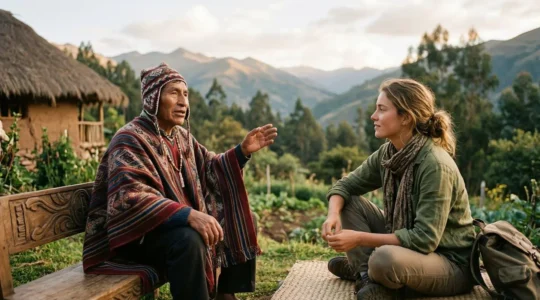
Most travelers believe respecting Indigenous culture means asking for photos and buying local, but this is a dangerously incomplete picture. True respect involves understanding the economic and narrative power dynamics of your visit, which often remain invisible. Your choices in…
Read more