
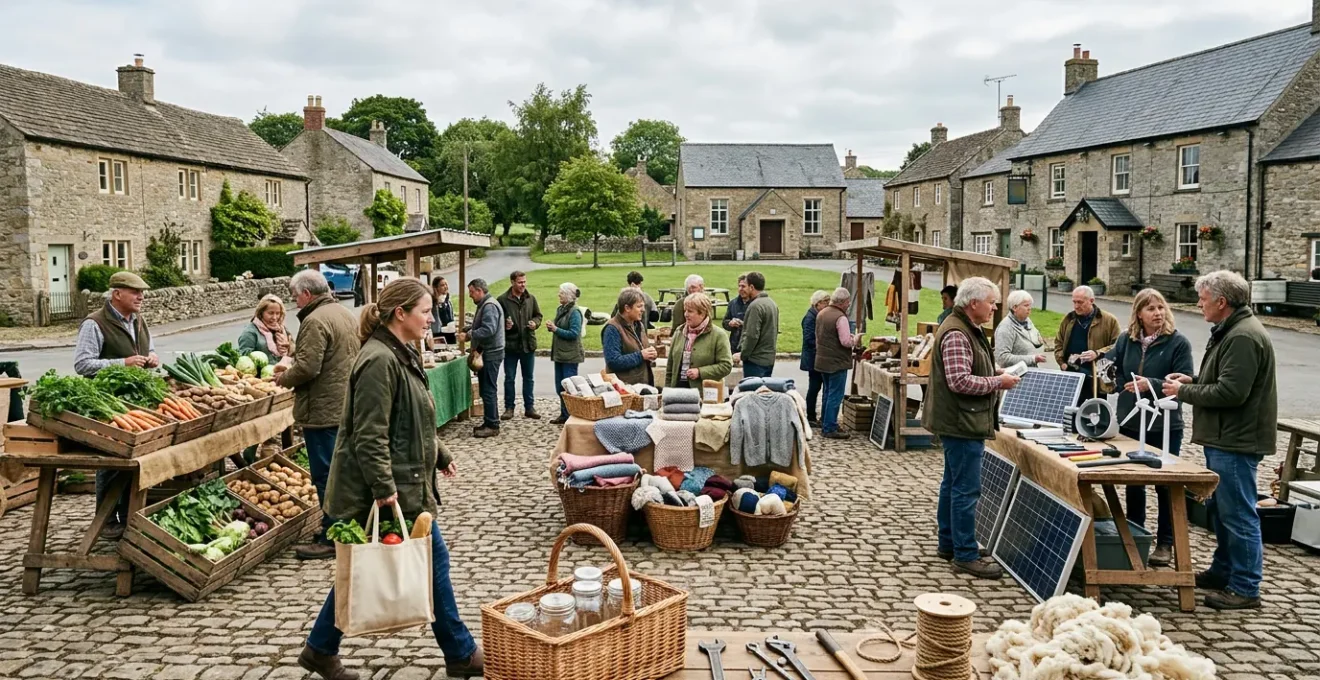
The fight for the UK’s rural high streets is not about nostalgia; it’s a battle against the systemic capital extraction engineered by large corporations.
- Spending locally has a multiplier effect, keeping significantly more money circulating in your community than spending at a chain.
- Supermarket supply chains can offer farmers as little as 1% profit, while direct-to-consumer models build true, resilient local wealth.
Recommendation: Shift your focus from passive spending to strategic investment in local suppliers, businesses, and community energy projects to build genuine economic sovereignty.
Walk down any rural high street in the UK, and the signs of a quiet crisis are impossible to ignore: boarded-up shops, “To Let” signs gathering dust, and the ubiquitous logos of national chains replacing once-thriving independent businesses. For years, the response has been a well-meaning but ultimately toothless plea to “shop local.” We’re told it’s the right thing to do, a way to preserve the character of our towns. But this narrative misses the point entirely. It frames local spending as a form of charity, a nostalgic nod to a bygone era.
The truth is far more brutal and far more empowering. The decline of our rural economies is not an accident; it’s the result of a system designed for capital extraction. Large, distant corporations have perfected the art of siphoning wealth out of our communities, leaving behind low-wage jobs and hollowed-out town centres. This isn’t about sentiment; it’s about economics. But if the system is the problem, then understanding that system is the solution.
This article is not another plea to feel guilty about your shopping habits. It is a strategic briefing. We will dismantle the mechanisms of economic leakage that are bleeding our communities dry. We will demonstrate, with hard data, why every pound spent locally is not just a purchase but an act of economic self-defence. The goal is not simply to “save the high street,” but to reclaim our economic sovereignty and build a resilient, self-sufficient future, protected from the volatility of global markets and corporate whims. We will explore the core principles of the local multiplier, the tactics for sourcing locally, the realities of our food supply chains, and the advanced strategies that turn isolated businesses into a powerful, collaborative economic force.
This guide provides a comprehensive overview of the strategies and mindset required to build a robust local economy. The following sections break down the key battlegrounds, from individual spending habits to community-wide investment and business collaboration.
Summary: How to Fortify Your Local Economy Against Corporate Extraction
- Why Spending £100 Locally Keeps £68 Within the Parish Economy?
- How to Source 80% of Your Household Goods From Independent Regional Suppliers
- Which Truly Benefits British Farmers Between Independent Farm Shops and Supermarket Local Aisles?
- When to Invest in Community Energy Projects for Maximum Regional Impact
- The Franchising Trap That Drains Capital From Thriving Coastal Towns
- Why White-Labelling Competitor Services Expands Your Market Share Overnight?
- Why Keeping £50k in Cash Guarantees a Devastating Loss of Purchasing Power?
- How to Forge Strategic B2B Partnerships to Scale Your Agency Without Hiring
Why Spending £100 Locally Keeps £68 Within the Parish Economy?
The single most powerful weapon in the fight for local economic sovereignty is a concept called the Local Multiplier Effect. It’s a simple idea with profound consequences. When you spend money at a business owned by a national or international corporation, the vast majority of that money is immediately extracted from your community. It goes to a distant head office, remote shareholders, and national supply chains. In contrast, money spent at a locally owned independent business tends to stay local. That business owner then spends it on other local services, pays local staff who spend it in the local pub, and sources from local suppliers. The same pound circulates multiple times, amplifying its value.
The difference is not trivial; it is a chasm. Research has consistently shown the dramatic impact of this effect. For example, analysis by the New Economics Foundation revealed that £10 spent at a farmers’ market resulted in about £25 of total local spending, whereas the same £10 spent at a supermarket generated only £14. This is the multiplier in action: your money works two to three times harder for your own community when you spend it locally. This increased velocity of money is what builds a resilient economy. It’s not just about one transaction; it’s about creating a virtuous cycle of reinvestment that supports a diverse ecosystem of local jobs and services. In essence, choosing an independent business isn’t a small gesture; it’s a direct investment in your neighbour’s prosperity and your town’s future stability.
How to Source 80% of Your Household Goods From Independent Regional Suppliers
Understanding the multiplier effect is the first step; acting on it is the second. The goal of sourcing the majority of your household needs locally may seem daunting in a world dominated by the convenience of one-stop supermarkets and online giants. However, it is more achievable than ever thanks to a growing network of circular economy initiatives. The key is to move away from the mindset of “all or nothing” and adopt a phased approach, starting with the low-hanging fruit and gradually building your network of regional suppliers. It requires a shift from being a passive consumer to an active, conscious sourcer of goods.
This process is about more than just buying vegetables from a farm shop. It’s about fundamentally re-evaluating our relationship with ownership and consumption. Community sharing schemes, tool libraries, and refill stations are all critical components of a thriving circular economy. They reduce waste, save money, and, most importantly, keep economic activity rooted firmly within the region. Research from the UK Southwest has shown that local ‘influencers’ and community groups are pivotal in creating these opportunities, demonstrating an “adaptive capability” to build these systems from the ground up. This isn’t a top-down corporate strategy; it is a grassroots movement for economic self-sufficiency.
Your 5-Step Plan for Regional Sourcing
- Start with the ‘Easy 20%’: Establish a regular delivery of local produce through a vegetable box scheme or join a Community Supported Agriculture (CSA) programme. This automates your first step into the local food network.
- Identify Refill Stations: Locate and start using local refill stations for staple cleaning supplies and household goods. Towns like Totnes and Stroud are pioneers in this area, but smaller stations are appearing across the UK.
- Shift from Ownership to Access: Before buying new equipment (like a pressure washer or a specific tool), check for a local Tool Library or community sharing scheme. This drastically reduces consumption and cost.
- Source from Makers: For furniture and home goods, seek out local carpenters, artisans, and upcyclers who use reclaimed materials. Participate in or organize community swap events for smaller items.
- Leverage Digital Platforms: Use online hubs like the Open Food Network or BigBarn. These platforms aggregate regional producers, making it just as convenient to source from multiple local suppliers as it is to do a single supermarket shop.
Which Truly Benefits British Farmers Between Independent Farm Shops and Supermarket Local Aisles?
The supermarket “local” aisle is a masterpiece of marketing, designed to placate the ethically-minded consumer while changing nothing about the fundamentally extractive relationship between large retailers and primary producers. It creates the illusion of support, but the economic reality for farmers is devastating. When a farmer supplies a large supermarket, they are at the mercy of a powerful, centralized buyer that dictates prices, imposes stringent cosmetic standards, and demands a supply chain that erodes almost all of the producer’s profit margin. They become a powerless cog in a vast, impersonal machine.
The numbers are a stark indictment of this system. Comprehensive research by Sustain found that for every £2.20 of apples sold in a supermarket, the grower might receive just 3 pence in profit—a shocking 1%. In stark contrast, selling directly to consumers through a farm shop, a farmers’ market, or a box scheme allows the farmer to retain a significantly larger share of the final price, often three times as much or more. This is the difference between subsistence and prosperity. It allows farmers to reinvest in their land, hire local staff, and innovate, rather than being trapped in a cycle of debt and dependency.
Therefore, the choice is clear. Buying from a supermarket’s “local” section primarily benefits the supermarket’s shareholders. Buying directly from a farm shop or a stall at the farmers’ market directly benefits the farmer, their family, and the local economy they are an integral part of. It bypasses the extractive middleman and ensures that the wealth generated from the land stays with the people who work it. Every direct purchase is a vote against a broken system and a direct investment in a more sustainable and equitable food system for the UK.
When to Invest in Community Energy Projects for Maximum Regional Impact
Moving beyond consumer spending, a truly resilient local economy requires proactive community investment in its own infrastructure. Nowhere is this more powerful than in the realm of energy. Community energy projects—where local people collectively own and profit from renewable energy installations like solar farms or wind turbines—represent a fundamental shift in power. Instead of paying bills to a multinational energy giant, the community generates its own power, sells the surplus to the grid, and reinvests the profits directly back into local initiatives. This is the circular economy in its most advanced form.
The best time to invest is when a project is in its fundraising stage, often through community share offers. This is the point of maximum impact, as your capital directly enables the construction of the asset. The potential is enormous. The UK community energy sector’s current capacity is 398 Mega Watts, but government ambitions target a twenty-fold increase, enough to power millions of homes. The impact is tangible; the Wiltshire Wildlife Community Energy project, for example, has already paid £45,000 from its profits into a community fund. This money has supported local environmental education projects and wildlife preservation, demonstrating a perfect virtuous cycle where energy profits fuel further local good.
Investing in a community energy scheme is a declaration of energy independence. It insulates the community from volatile global energy prices, creates a long-term revenue stream for local projects, and provides a powerful, visible symbol of a region taking control of its own destiny. It transforms residents from passive bill-payers into active stakeholders in their own infrastructure.
The Franchising Trap That Drains Capital From Thriving Coastal Towns
Franchises, particularly the ubiquitous fast-food chains and coffee shops, are often presented as a boon for local economies, creating jobs and filling empty storefronts. This is a dangerous illusion. In reality, the franchise model is one of the most efficient systems ever devised for capital extraction from local communities, especially in seasonal tourist hotspots like coastal towns. While a local entrepreneur may run the establishment, the model is designed to systematically siphon money out of the region.
A significant portion of every pound spent in a franchise is immediately lost to the local economy. This happens through multiple channels: mandatory franchise fees and royalties paid to the corporate head office, the requirement to purchase all supplies from the corporation’s national or international supply chain, and the profits which ultimately flow to distant, often overseas, shareholders. As iLocal Inc. highlights, this is the core of the problem:
Chain stores rely on out-of-region supply chains, use corporate services from headquarters, pay royalties or franchise fees out of state, and send profits to distant shareholders. A portion of every dollar spent immediately leaves in the form of sourcing goods from elsewhere and corporate overhead allocations.
– iLocal Inc., The Local Multiplier Effect: Latest Research
The data confirms this ‘economic leakage’. Research shows that only 10-20% of a pound spent at a chain store stays local, primarily through the wages of low-paid staff. Compare this to the 45-60% that stays local from a purchase at an independent business. For a thriving coastal town, a high street lined with franchises may look busy, but it is an economic sieve, constantly draining away the wealth generated by tourism. Supporting a local, independent café or takeaway is a direct counter-attack against this extractive model.
Why White-Labelling Competitor Services Expands Your Market Share Overnight?
Building a resilient rural economy requires a mindset shift among local businesses, moving from zero-sum competition to strategic collaboration. The principles of a circular economy are not just about waste reduction; they are about strengthening the entire local business network. One of the most powerful, yet underutilised, strategies in this arsenal is ‘white-labelling’ or collaborative service provision. This is a tactic where a local business sells another local business’s service under its own brand.
Imagine a local web design agency. Instead of turning away a client who needs professional photography, they partner with a local photographer. The agency sells a complete “web and photography package” under its own brand, handling the client relationship, while the photographer provides the service. The agency expands its offering without hiring, the photographer gains a new client without marketing spend, and—crucially—the entire project fee stays within the local economy, rather than being lost to a national stock photography site or a remote freelancer. This model is built on trust and a shared understanding that a rising tide lifts all boats.
This approach embodies the ‘adaptive capability’ that researchers have identified in strong regional economies. Businesses co-create opportunities, filling gaps in the local market and presenting a unified, more professional front to clients. It allows small, specialised businesses to compete with larger, full-service agencies by pooling their collective strengths. It turns direct competitors into a powerful, collaborative supply chain, expanding the market for everyone and making the entire local business ecosystem more robust and anti-fragile.
Why Keeping £50k in Cash Guarantees a Devastating Loss of Purchasing Power?
In a traditional financial mindset, holding a significant amount of cash in a savings account feels safe. In reality, it is a guaranteed way to lose purchasing power due to inflation. More importantly from a localist perspective, that money is inert. It sits in a national bank, which invests it in global markets, doing absolutely nothing for your local community. The opposite of hoarding cash is increasing its local velocity—making it work for the community.
The iconic Bristol Pound scheme was a masterclass in this principle. By creating a complementary local currency, the project forced money to stay and circulate within Bristol’s economy. A pound sterling could be exchanged for a Bristol Pound, but the Bristol Pound could only be spent with participating local businesses. It couldn’t ‘leak’ out to national chains or online retailers. At its peak, over £5 million in Bristol Pounds had been spent, with each one circulating and creating value multiple times over before it was eventually converted back to sterling. It was a closed loop designed to maximise local economic activity.
While the Bristol Pound itself has ended, the lesson is profound. Keeping your savings locked away in a national bank is a vote for the status quo. Investing that same money in a local business, a community energy share offer, or a local credit union actively puts your capital to work for your own region. It’s the difference between your money being a sleeping soldier in a distant barracks and an active fighter on the front line of your local economy. Hoarding cash is a passive act of submission to a system that devalues it; investing it locally is an active strategy for building community wealth.
Key Takeaways
- The Multiplier Effect is Real: Every pound spent at an independent local business circulates 2-3 times more within your community than a pound spent at a national chain, creating a powerful ripple effect of prosperity.
- Capital Extraction is the Enemy: Supermarket supply chains and franchise models are systems designed to siphon wealth out of local communities. Resisting them is an act of economic self-defence.
- Invest in Local Infrastructure: Moving beyond consumerism to become an investor in community-owned assets like renewable energy projects creates long-term, self-sustaining revenue for your region.
How to Forge Strategic B2B Partnerships to Scale Your Agency Without Hiring
The final piece of the puzzle for achieving true regional economic resilience is for local businesses to think and act as a coordinated network. For small agencies, consultants, or service providers in rural areas, the pressure to compete with larger, city-based firms can be immense. The traditional route of scaling through hiring is slow, expensive, and risky. The circular economy offers a more agile, collaborative, and powerful alternative: strategic B2B partnerships.
This is the culmination of the white-labelling concept, expanded into a formal strategy. Local businesses should actively map out the skills and services present in their regional network and identify gaps. A marketing agency can partner with a local printer, a videographer, and a PR consultant to offer integrated campaigns that rival any national competitor. They can share leads, subcontract work, and pitch for larger contracts together. This creates a resilient, multi-disciplinary ecosystem where businesses are partners, not just rivals. This collaborative model is a powerful engine for job creation; the International Labour Organization estimates the global shift to a circular economy could generate up to 8 million jobs, and this localised, service-based collaboration is a key part of that.
Circular economy practices can help rural regions overcome challenges. CE practices have been shown to create new economic opportunities, such as reducing waste, and supporting sustainable livelihoods… Considering the unique characteristics of rural communities can develop context-specific CE strategies that support sustainable and resilient rural communities.
– Ruth Cherrington, Constantine Manolchev, et al., Enabling circular economy practices in regional contexts: Insights from the UK Southwest
By forging these alliances, rural businesses cease to be isolated entities. They become a networked force, capable of retaining talent, winning larger projects, and ensuring that the wealth generated by their expertise builds a more prosperous and sophisticated local economy for all.
The first step is to see every pound you spend not as a simple transaction, but as a strategic vote for your community’s future. Start today by diverting just one weekly purchase from a national chain to an independent local supplier, and you have begun the fight to reclaim your local economy.