
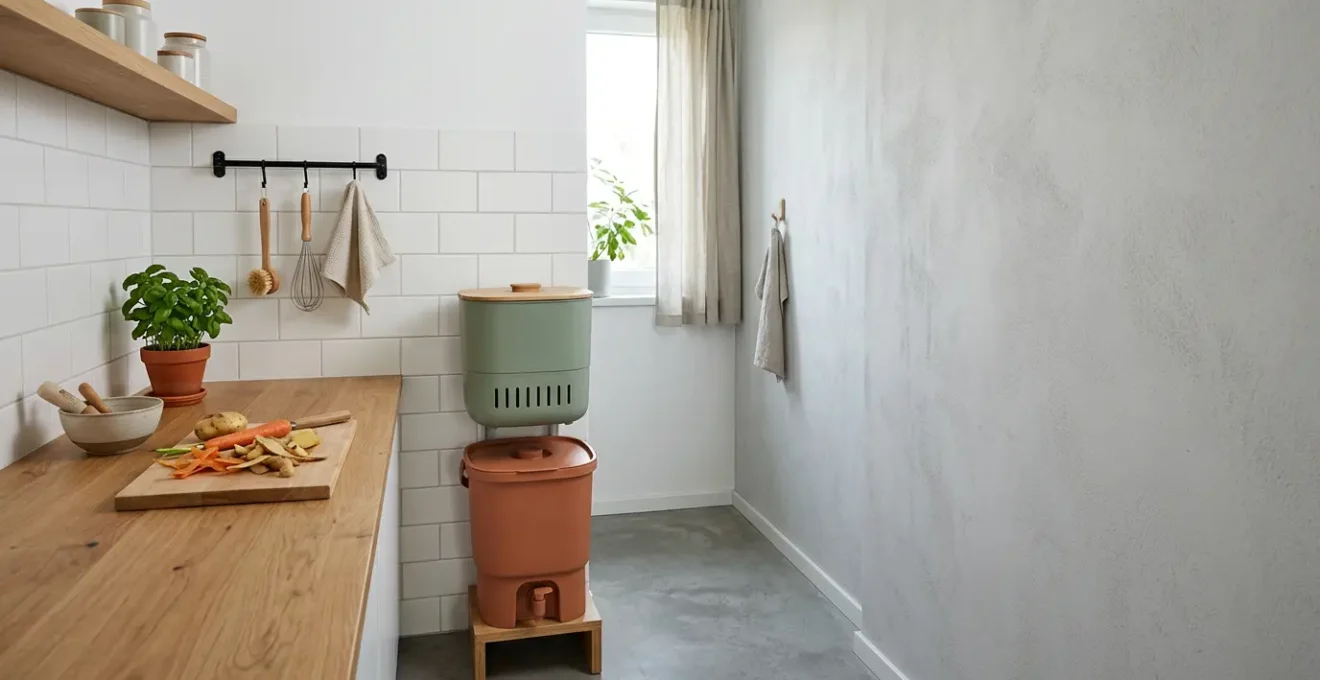
Achieving a truly zero-waste kitchen in a small flat is possible without the smells, pests, or mess you fear.
- Standard “biodegradable” bags often fail in landfills; the solution lies in a controlled indoor system.
- A sealed Bokashi bin ferments all food scraps (including meat) odourlessly, while vermicomposting and smart repurposing handle the rest.
Recommendation: The key is to see your kitchen as a micro-ecosystem where you manage inputs like coffee grounds and paper to create a balanced, waste-free loop.
Living in a small urban flat often feels like a battle between your eco-conscious aspirations and the practical realities of your space. You see the food scraps piling up, feel the pang of guilt with every full bin bag, and want to do better. Yet, the leap to composting is stalled by potent fears: the horrifying prospect of a smelly kitchen, an invasion of fruit flies, or a system that simply doesn’t work. It feels like a choice between your conscience and your comfort.
The common advice—”just get a compost bin”—and the misleading promises on “biodegradable” bags only add to the confusion. These solutions often ignore the fundamental science of decomposition and the unique constraints of a small, enclosed living space. They treat the symptom, not the cause, leaving you with a soggy, smelly mess that confirms your worst fears. But what if the problem isn’t composting itself, but the way we’ve been told to approach it?
The real secret to a successful zero-waste kitchen isn’t a magic bin; it’s a shift in perspective. It’s about seeing your kitchen not as a place that generates waste, but as a tiny, controllable micro-ecosystem. By understanding and managing the processes of fermentation and decomposition, you can turn the very points of failure—smells, pests, and material mismatches—into signals you can easily control. This guide will walk you through building that resilient system, transforming fear into empowerment and waste into valuable resources.
This article provides a comprehensive roadmap, breaking down the science and practical steps for each component of a truly functional urban composting system. Explore the sections below to master each element of your new zero-waste kitchen.
Summary: A Complete System for a Zero-Waste Urban Kitchen
- Why Standard Biodegradable Bin Liners Never Decompose in Local Authority Landfills?
- How to Manage an Odourless Bokashi Bin Under the Kitchen Sink Successfully
- The Meat Scrap Mistake That Attracts Urban Pests Instantly
- Which Handles Daily Coffee Grounds Better Between Vermicomposting and Countertop Dehydrators?
- How to Repurpose Onion Skins and Vegetable Peelings Into Rich Homemade Bouillon
- The Forced Recipe Adherence Error That Drives Up Food Waste Costs
- How to Declutter Sentimental Items Without Experiencing Intense Emotional Guilt
- How to Transform a Cramped 50m2 Flat Into a Calm Minimalist Urban Living Space
Why Standard Biodegradable Bin Liners Never Decompose in Local Authority Landfills?
The first hurdle in any urban composting journey is the bin bag itself. You conscientiously buy “biodegradable” or “compostable” liners, feeling you’ve made a green choice. The reality, however, is a stark lesson in material science and waste management infrastructure. These bags are designed to break down under specific conditions—namely, the high heat and oxygen-rich environment of an industrial composting facility. Your local authority landfill is the exact opposite of this.
Landfills are packed so tightly that they create an anaerobic (oxygen-free) environment. Without oxygen, the microorganisms needed for decomposition can’t thrive. Furthermore, these specialized bags require sustained heat to break apart their polymer chains. Research confirms that most landfills don’t reach the 50-60°C needed for this process to even begin. Your “eco-friendly” bag, along with its organic contents, ends up mummified, releasing methane—a potent greenhouse gas—as it very slowly degrades over decades, if not centuries.
A landmark study powerfully illustrates this failure. In the UK, marine biologists conducted a three-year experiment on various types of “eco” bags.
The Plymouth University 3-Year Bag Study
Researchers placed five different types of biodegradable and compostable bags in soil, seawater, and open air. After three years, not a single bag had fully decomposed in all environments. Most shockingly, a “biodegradable” bag that had been buried in soil for three years was not only intact but was still strong enough to carry about 5 pounds of groceries. This demonstrates that the “biodegradable” label does not guarantee decomposition in natural or landfill conditions, effectively preserving waste instead of eliminating it.
The takeaway is clear: relying on these bags is counterproductive. The solution isn’t a better bag, but a better system—one that processes waste *inside* your flat, before it ever has a chance to reach a landfill. This is the foundational principle of a true zero-waste kitchen.
How to Manage an Odourless Bokashi Bin Under the Kitchen Sink Successfully
If traditional bags fail, what’s the alternative? Enter the Bokashi bin. This is the cornerstone of the odour-free urban compost system. Unlike traditional composting, which involves decomposition and requires a careful balance of “greens” and “browns,” Bokashi is an anaerobic fermentation process. Think of it like making pickles or sourdough rather than creating a rotting pile. It uses a special inoculant (EM-1 microbes, often in bran) to ferment all your food scraps, including the ones forbidden in regular compost: meat, dairy, oils, and cooked foods.
The magic of the Bokashi system is its sealed, oxygen-free environment. When the lid is tightly closed, the microbes get to work, pre-digesting the food waste without producing the foul-smelling gases associated with aerobic decay. Instead of rot, you get a slightly sweet, pickled smell when you open the bin, which dissipates in seconds. The process also generates a nutrient-rich “Bokashi tea,” a liquid fertilizer you must drain every few days to prevent sogginess—the primary cause of bad smells.
This is what a healthy, active Bokashi system looks like up close—not rot, but a living, fermenting micro-ecosystem.
The white, fuzzy substance is beneficial mycelium, a sign that the fermentation is working perfectly. Managing this system is about maintaining this healthy state. By pressing scraps down to remove air, draining the tea regularly, and keeping the lid sealed, you create an environment where odour-producing bacteria simply cannot survive.
The Meat Scrap Mistake That Attracts Urban Pests Instantly
The single biggest composting error for city dwellers is attempting to compost meat or dairy scraps in a traditional, open-air, or vermicompost system. This is a guaranteed invitation for pests, from rats and raccoons on a balcony to an explosion of flies indoors. The reason is simple: these materials decompose slowly and putrefy, releasing strong odours that act as a powerful beacon for scavengers. This is the mistake that gives composting its bad reputation in urban environments.
However, the absolute rule of “no meat or dairy” only applies to decomposition-based composting. The Bokashi system, being a fermentation process, completely changes the game. By pickling the scraps in an anaerobic environment, it neutralizes the putrefying odours before they can form. Meat and bones are broken down at a chemical level, making them unappealing and largely undetectable to pests once the fermented material is later buried in soil or added to a larger compost pile.
This distinction between fermentation and decomposition is the key to handling all of your kitchen waste safely. As composting experts explain, the process fundamentally alters the material.
Bokashi composting is a method that utilizes a special type of bacteria to ferment kitchen waste instead of decomposing it. This anaerobic process allows for the breakdown of various food scraps, including meat and dairy products.
– Trash Butler Composting Services, Trash Butler Apartment Composting Guide
The fermented Bokashi material, known as “pre-compost,” is highly acidic when it first comes out of the bin, which also acts as a deterrent to pests and unwanted pathogens. After a couple of weeks in soil, this acidity neutralizes, and the material becomes a super-food for the soil web. Therefore, the “mistake” is not the meat scrap itself, but applying the wrong process to it. By using a Bokashi system, you can confidently process these items, as urban composter research confirms it can handle meat and even small bones, truly closing the loop on your kitchen waste.
Which Handles Daily Coffee Grounds Better Between Vermicomposting and Countertop Dehydrators?
Your daily coffee ritual produces a consistent stream of one of the best possible soil amendments: used coffee grounds. But how do you best process them in a small flat? Two popular options are vermicomposting (a worm bin) and electric countertop dehydrators (like the Lomi). While dehydrators are fast and simple—zapping waste into a dry, sterile powder—they are energy-intensive and destroy the microbial life that makes compost valuable.
Vermicomposting, on the other hand, is a living system that turns grounds into “black gold,” the richest form of compost. However, many people fail when they simply dump fresh grounds into their worm bin. The problem lies in the pH. Coffee grounds are acidic, and overloading a bin can create an environment that is stressful or even fatal to the worms. This is a classic case of not managing the micro-ecosystem. A 2025 study highlights the dramatic effect of this imbalance: simply adding grounds can lead to low survival rates. However, the solution is remarkably simple: buffering.
The study found that by adding a carbon-rich, pH-neutral material like shredded cardboard or crushed eggshells, you can completely offset the acidity. The research showed this simple act of balancing can increase earthworm survival from a dismal 16-24% to a thriving 62-81%. This transforms the problem into a perfect partnership.
This image perfectly symbolizes the solution: balancing the dark, acidic “greens” (coffee grounds) with the light, alkaline “browns” (crushed eggshells or paper). A well-managed worm bin will process coffee grounds far more effectively and sustainably than a dehydrator, creating a nutrient-dense amendment for your houseplants without the ongoing energy cost. It’s not about which method is “better” in a vacuum, but which one creates the most value when managed correctly.
How to Repurpose Onion Skins and Vegetable Peelings Into Rich Homemade Bouillon
A true zero-waste system isn’t just about diverting waste from landfill; it’s about extracting the maximum value from every item before it’s composted. Vegetable scraps like onion skins, carrot peels, and celery ends are a prime example. While they are excellent for the compost bin, they have a higher calling first: becoming free, delicious, and nutrient-rich homemade bouillon.
The mistake many people make is trying to save scraps in a container in the fridge, where they quickly wilt or grow mould. The solution is the “Freezer Scrap Bag System.” It’s incredibly simple: designate a large, reusable bag or container that lives permanently in your freezer. Every time you cook, add your clean vegetable offcuts to the bag. The freezer keeps them perfectly preserved and prevents any odours, allowing you to collect them over weeks or even months.
When the bag is full, you simply empty the frozen scraps into a large pot, cover them with water, add a few peppercorns and a bay leaf, and simmer for an hour. Strain the liquid, and you have a flavourful vegetable broth for soups, stews, or cooking grains. But here’s the final, crucial step in the zero-waste loop: the boiled-out, now pale and mushy scraps don’t go in the bin. They can now be added to your Bokashi bin or worm farm. You’ve successfully extracted their flavour and nutrients for your food, and are now returning their organic matter to the soil.
Your Action Plan: The Freezer Scrap Bag System
- Designate a labeled bag or container in the freezer specifically for vegetable scraps.
- Add approved scraps: onion/garlic skins, carrot peels, celery ends, and mushroom stems are excellent.
- Avoid adding brassicas like broccoli or cabbage, which can turn the stock bitter, and starchy potato peels that make it cloudy.
- Aim for a balanced ratio for best flavour: roughly 2 parts onion skins for umami, 1 part carrot peels for sweetness, and 1 part celery or herb stems for aromatics.
- After simmering the bouillon, add the boiled-out scraps to your vermicompost or Bokashi bin to complete the material usage cycle.
This simple habit transforms something you once saw as trash into two valuable resources: delicious broth and food for your compost system. It’s a perfect example of the zero-waste mindset in action.
The Forced Recipe Adherence Error That Drives Up Food Waste Costs
While managing scraps is crucial, a truly zero-waste system addresses the problem at its source: purchasing habits. One of the most significant, yet often overlooked, drivers of food waste in home kitchens is what can be called “forced recipe adherence.” This is the cycle of finding an exciting new recipe, creating a specific shopping list, and buying ingredients—some of them exotic or in large quantities—for that single use.
You buy a whole bunch of celery for the two stalks the recipe calls for, a large container of a specific herb for a single tablespoon, or a specialty spice you never use again. The rest of the ingredients languish in the back of your fridge until they spoil and are thrown away. This behaviour is a major contributor to the staggering cost of food waste. While data varies by country, the financial impact is significant; for example, EPA household food waste data shows the average American family of four loses around $1,500 per year to uneaten food.
Research confirms the direct link between this behaviour and the amount of waste produced. An extensive study on household food waste by the NRDC analyzed kitchen diaries and found that buying specific ingredients for single recipes was a primary cause of food spoilage. The problem is a rigid, top-down approach to cooking. The zero-waste mindset flips this. Instead of asking, “What should I buy to make this recipe?” you ask, “What recipe can I make with what I have?”
This “pantry-first” approach encourages creativity and flexibility. It means learning basic techniques and flavour combinations so you can substitute ingredients freely. It’s about seeing your pantry and fridge as the starting point, not a shopping list. By breaking free from the tyranny of the recipe, you not only slash your food waste and save money but also become a more intuitive and resourceful cook.
How to Declutter Sentimental Items Without Experiencing Intense Emotional Guilt
A zero-waste lifestyle inevitably leads to minimalism and decluttering. But what about those items that spark not joy, but guilt? The shoebox of old birthday cards, letters, or children’s drawings. You can’t bear to throw them in the bin, yet they take up precious space in your small flat. This is where your composting system can provide a surprisingly elegant and emotionally resonant solution for paper-based memorabilia.
The “Digital & Decompose” method offers a respectful way to let go of the physical object while honouring the memory it holds. The process is a ritual. You take the time to scan or photograph the item, preserving its image and message forever in a digital archive. You are not erasing the memory; you are transforming it into a more durable and space-efficient format. This act of preservation often provides the emotional permission you need to release the physical object.
Once digitized, you can ceremonially shred the paper-based items (non-glossy cards, letters, most photos). And here is the final, beautiful connection to your zero-waste system: this shredded paper is not waste. It is the perfect “brown” carbon-rich material to balance your worm bin or add dry matter to your Bokashi. The letter from a grandparent doesn’t go to a landfill; it gets transformed by worms into nutrient-rich soil that can grow new life. It’s a poetic, circular, and deeply satisfying way to close the loop.
Your Action Plan: The Digital & Decompose Method for Sentimental Paper
- Scan or photograph paper-based sentimental items (old letters, cards, non-glossy photos) to create a digital memory archive.
- Ceremonially shred the natural fibre paper items after digitization, acknowledging the memory as you do.
- Add the shredded paper to your vermicompost bin as a valuable carbon-rich ‘brown’ material to balance the ‘greens’.
- For non-compostable sentimental items, write down the story and memories associated with the object before donating it.
- Use a 6-month ‘purgatory box’ for items you’re uncertain about. If you don’t need or think about them in that time, it’s a sign you can let go.
This method reframes decluttering from a guilty act of disposal into a mindful process of transformation and renewal, perfectly aligning the principles of minimalism with the cycles of nature.
Key Takeaways
- Bokashi fermentation is the key to handling all food scraps (incl. meat) without odours in a small space.
- Successful composting is about balancing your “micro-ecosystem” by managing factors like acidity and moisture.
- A true zero-waste system extends beyond food, offering ways to upcycle scraps and even process sentimental clutter.
How to Transform a Cramped 50m2 Flat Into a Calm Minimalist Urban Living Space
The ultimate reward of a fully implemented zero-waste kitchen system extends far beyond just taking out the bins less often. It is the profound transformation of your living space. By consciously managing the flow of materials in and out of your home—from food and packaging to sentimental items—you cultivate an environment of intention, calm, and surprising spaciousness.
The fear that a composting system will add clutter is unfounded when designed correctly. In fact, the opposite is true. The system itself is incredibly compact; according to Bokashi Living apartment composting research, a highly efficient stacked Bokashi and vermicompost system can occupy a tiny footprint of just 40x40cm, easily tucked away under a sink or in a small cupboard. The real space-saving comes from the mindset it fosters. You buy less, you store less, and you hold onto less “just in case” stuff. Your kitchen and home begin to breathe.
This philosophy of “a place for everything, and everything in its place” expands. Food is no longer just “food” but ingredients to be used or scraps to be repurposed or fermented. Paper is not clutter but carbon for the worm bin. An empty space on a shelf is not a void to be filled, but “negative space” that brings a sense of calm and order. The discipline required to manage a small micro-ecosystem in your kitchen becomes a transferable skill for managing your entire home.
The result is a living space that feels intentional, not accidental. It is calm, functional, and aligned with your values. The absence of overflowing bins, cluttered countertops, and a fridge full of expiring food creates a mental and physical lightness that is the true luxury of minimalist urban living. You didn’t just eliminate waste; you created a sanctuary.
Start today by choosing one element—the freezer bag for scraps, or a single paper item to digitize. Your calm, zero-waste space begins not with a giant leap, but with a single, mindful step.