
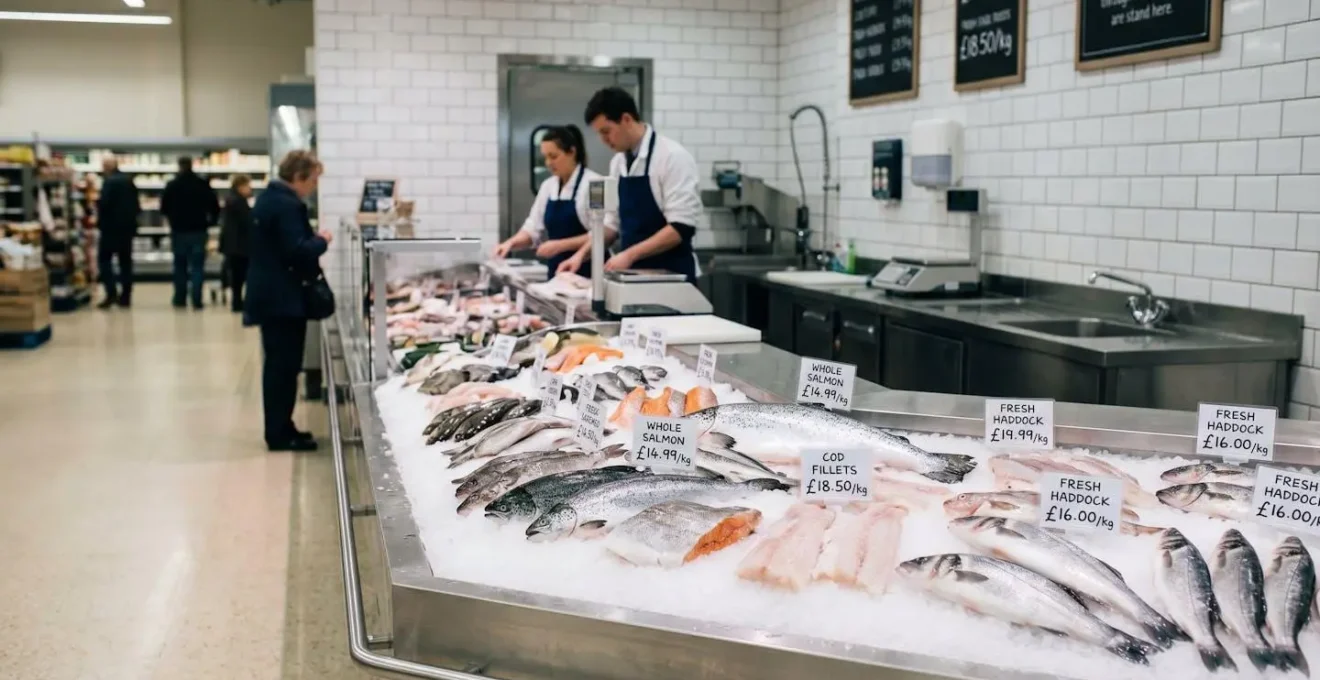
In summary:
- Farmed salmon often carries significant environmental costs, including high mortality rates and disease, which are not always transparent to consumers.
- The fishing method (e.g., pole-and-line vs. scallop dredging) is frequently a more critical indicator of sustainability than the species of fish itself.
- Certification labels like the MSC’s blue tick are a starting point, but require active verification to understand the full story of your seafood.
- Vague marketing terms like “Ocean-Caught” or “Produced in the UK” can obscure unsustainable practices and should be treated with skepticism.
Standing at the supermarket fish counter can feel like a test of your conscience. You want to make an ethical choice, to enjoy fish without contributing to the depletion of our precious marine ecosystems. The common advice is to “look for the blue logo” or “buy British,” but in a sea of confusing labels and marketing claims, this often feels inadequate. You’re left wondering if your choice truly makes a difference or if you’re just falling for clever packaging.
The reality is that simple rules of thumb are no longer enough. The challenges facing our oceans—from destructive fishing practices to the complexities of aquaculture—are too nuanced for a one-size-fits-all solution. As a marine conservationist who works closely with the British fishing industry, I’ve seen firsthand how well-intentioned shoppers can be misled by incomplete information.
But what if the key wasn’t to memorise a list of ‘good’ and ‘bad’ fish, but to learn how to become a critical investigator right there in the aisle? This guide moves beyond the platitudes. It’s designed to equip you with the forensic skills to decode the hidden signals on packaging, to question what certifications really guarantee, and to understand the real-world impact of your purchasing decisions. We’ll explore the science and economics behind the labels, empowering you to hold retailers and fisheries accountable.
This article will provide you with the essential tools and knowledge to navigate the complexities of the seafood counter. From understanding the nuances of salmon farming to identifying misleading labelling and recognising the most impactful certifications, you will learn to make choices that genuinely support the health of our oceans.
Summary: A Shopper’s Guide to Sustainable Seafood
- Why Farm-Raised Salmon Often Causes More Ecological Damage Than Wild Catch?
- How to Identify the MSC Blue Tick and Decipher Confusing Catch Zones
- Which Represents the Absolute Worst Bycatch Risk Between Pole-and-Line Tuna and Dredged Scallops?
- The Vague Labelling Trick That Disguises Depleted Fish Stocks as Eco-Friendly
- When is the Best Season to Buy British Mackerel at Its Most Plentiful?
- Which Certification Actually Guarantees Sustainable Practices Between Rainforest Alliance and Green Key?
- How to Track the Financial Impact of Your £500 Safari Permit
- How to Ensure Your Funds Support Genuine Biodiversity Conservation Destinations
Why Farm-Raised Salmon Often Causes More Ecological Damage Than Wild Catch?
Farmed salmon is often marketed as a sustainable alternative to wild-caught fish, a solution to overfishing. However, the industrial scale of modern aquaculture, particularly in regions like Scotland, presents a host of severe ecological problems that are rarely visible on the supermarket shelf. The sheer density of fish in open-net pens creates a breeding ground for diseases and parasites, most notably sea lice, which can then spread to and decimate wild fish populations.
The statistics paint a grim picture of the conditions. In Scotland’s salmon farming industry, a staggering 17.4 million salmon died prematurely in 2023, representing a mortality rate of over 31%. These aren’t just numbers; they represent systemic issues with animal welfare and environmental management. Events like the mass mortality at Mowi’s Loch Torridon farm, a major supplier to UK supermarkets, highlight how gill diseases and other stressors are rampant. This isn’t an isolated incident but a symptom of an industry pushing for growth at the expense of ecological stability.
Furthermore, the environmental impact extends beyond the pens. The use of acoustic deterrent devices, or ‘seal scarers’, to protect the farms can cause significant disturbance and potential hearing damage to protected marine mammals like dolphins and porpoises. Waste from the farms, including excess feed and faeces, smothers the seabed, creating anoxic ‘dead zones’ where little can survive. This evidence demonstrates that while ‘farmed’ might sound responsible, the industrial reality often carries a heavier ecological price than truly sustainable wild-catch methods.
Understanding these hidden costs is the first step toward making a more informed choice, prompting us to look beyond the simple “farmed” label and question the production methods behind it.
How to Identify the MSC Blue Tick and Decipher Confusing Catch Zones
The Marine Stewardship Council (MSC) blue fish logo is the most recognised mark of sustainable wild-caught seafood in the UK. Seeing it on a product is a good first step, but it shouldn’t be the end of your investigation. True accountability comes from using the tools the MSC provides to perform your own ‘supply chain forensics’. Every certified product carries a code that unlocks a wealth of information about its journey from ocean to plate, allowing you to move from being a passive consumer to an active auditor.
This process is about verifying the promise on the packet. It allows you to see the specific fishery, the fishing method used, and the exact FAO (Food and Agriculture Organization) catch area. Why does this matter? Because a species might be sustainable in one ocean region but critically endangered in another. The label alone doesn’t tell you this, but the traceability code does. By cross-referencing this data with resources like the Marine Conservation Society’s Good Fish Guide, you can build a complete, nuanced picture of your purchase’s sustainability credentials.
This verification is not just an academic exercise; it’s a powerful action. It sends a clear message to retailers and the fishing industry that consumers are paying attention and demand genuine transparency. Taking a few minutes to check a code reinforces the value of the entire certification system and helps ensure the blue tick remains a meaningful guarantee of sustainability, not just a marketing tool.
Your Action Plan: MSC Traceability Verification
- Locate the Logo and Code: Find the MSC blue fish logo on packaging at major UK retailers like Tesco, Sainsbury’s, or Waitrose. Look for the traceability code printed nearby, which typically starts with ‘MSC-C-‘.
- Use the ‘Track a Fishery’ Tool: Visit the official MSC website and navigate to their traceability tool. Enter the full code you found on the packaging.
- Review the Origin Data: The tool will reveal the certified fishery, the specific fishing method (e.g., longline, purse seine), and the FAO fishing area where it was caught.
- Cross-Reference for Context: Take the species and catch zone information and look it up on the Marine Conservation Society’s Good Fish Guide for an independent UK-specific rating and further context.
- Make an Informed Decision: Armed with this detailed information, you can now confidently assess if the product aligns with your ethical standards, moving beyond simple trust in the logo.
This proactive approach is the most effective way to ensure the seafood you buy truly comes from a well-managed and sustainable source.
Which Represents the Absolute Worst Bycatch Risk Between Pole-and-Line Tuna and Dredged Scallops?
When evaluating sustainability, the fishing method is often more important than the species itself. Two methods could not be more different in their impact: selective pole-and-line fishing for tuna and industrial dredging for scallops. While both can end up on your plate, their ecological cost is worlds apart, especially concerning bycatch—the unintended capture of non-target species.
Pole-and-line fishing is a highly selective method. Fishers catch tuna one by one, meaning there is virtually zero bycatch. Any non-target fish that is accidentally caught can be returned to the ocean, usually unharmed. It is a targeted, low-impact technique that has no contact with the seabed.
In stark contrast, scallop dredging is one of the most destructive forms of fishing used in UK waters. Heavy metal cages with raking teeth are dragged across the seabed, indiscriminately scooping up everything in their path. This not only captures the target scallops but also a huge volume of other marine life. A 2016 study of UK scallop dredge fisheries found bycatch could constitute up to 53% of the total catch biomass around the Isle of Man. This collateral damage includes crabs, starfish, and other fish, most of which are thrown back dead or dying. The practice also obliterates fragile seabed habitats like maerl beds and seagrass, which are vital nurseries for many marine species and can take decades, if not centuries, to recover.
The following table starkly illustrates the difference in impact between these two methods.
| Fishing Method | Target Species | Bycatch Rate | Seabed Impact | Recovery Time | UK Supermarket Availability |
|---|---|---|---|---|---|
| Pole-and-Line | Tuna | Near zero (highly selective) | None | Not applicable | Available as ‘Pole-and-Line’ or ‘FAD-Free’ labeled tuna |
| Scallop Dredging | King Scallop | 15-53% of total catch biomass | Penetrates 3-10cm into seabed, destroys biogenic habitats | 1 to 10+ years depending on habitat type | Widely available; look for ‘diver-caught’ alternative |
For an ethical pescatarian, choosing pole-and-line caught tuna or, in the case of scallops, seeking out the much rarer ‘diver-caught’ alternative, is one of the most impactful decisions you can make at the fish counter.
The Vague Labelling Trick That Disguises Depleted Fish Stocks as Eco-Friendly
Beyond certifications, the very words used on seafood packaging can be a tool for ‘greenwashing’—the practice of making misleading claims about environmental benefits. Marketers often use vague, comforting language to create an illusion of sustainability without providing any verifiable proof. As a conscious shopper, learning to spot these “red flag” terms is crucial to avoid being misled.
One of the most common tricks is ‘geographic obfuscation’. A label stating ‘Produced in the UK’ can be highly deceptive. While the fish may have been processed or packaged in a British facility, such as in Grimsby or Peterhead, it could have been caught using unsustainable methods in a depleted fishery thousands of miles away. The label creates a positive association with local sourcing while hiding a potentially damaging international supply chain. Similarly, broad terms like ‘Ocean-Caught’ or ‘Sea-Caught’ sound natural and appealing but are utterly meaningless from a sustainability standpoint. They tell you nothing about how or where the fish was caught.
Even regulatory changes can inadvertently create confusion. A 2024 revision by DEFRA changed the official label for Scottish salmon with Protected Geographical Identification (PGI) from ‘Scottish Farmed Salmon’ to simply ‘Scottish Salmon’. This makes it harder for consumers to distinguish between farmed and wild-caught products, potentially masking the environmental issues associated with intensive salmon farming behind a premium, territorially-branded label. To arm yourself against this, it’s vital to know what to look for.
- Red Flag: ‘Ocean-Caught’ or ‘Sea-Caught’ – These terms are meaningless without specifics on the catch method and location.
- Red Flag: ‘Responsibly Sourced’ – Without an independent, third-party certification logo (like MSC or ASC), this is just a self-made claim by the company.
- Red Flag: ‘Produced in the UK’ – This refers to processing, not origin. Always look for the catch area.
- Red Flag: Generic Names like ‘Whitefish’ – This can hide a mix of species, including some that are overfished. Demand specific species names like cod or haddock.
- Red Flag: Nature Imagery – Blue and green packaging with pictures of pristine oceans means nothing without a credible certification logo.
Your best defence is to always prioritise clear, specific information and verifiable third-party certifications over vague marketing slogans.
When is the Best Season to Buy British Mackerel at Its Most Plentiful?
A common piece of sustainability advice is to “eat with the seasons.” For fish, this generally means buying a species when it is most abundant in local waters. For British mackerel, that peak season is traditionally summer. However, the ‘seasonality myth’ is the dangerous assumption that ‘in season’ automatically means ‘sustainable’. The recent history of North-East Atlantic mackerel provides a sobering case study that proves that ecological health is far more complex than a calendar date.
Mackerel was once a champion of UK sustainable seafood. But in recent years, international disputes over fishing quotas, particularly following Brexit, have led to a collective overfishing of the stock. Despite scientific advice from the International Council for the Exploration of the Sea (ICES) for a 70% catch reduction, political agreements fell short, leading the fishery to lose its crucial MSC certification. This demonstrates that political management is as critical as biological abundance. A fish can be plentiful in the water, but if nations fail to agree on sustainable catch limits, the stock’s long-term health is compromised.
This situation puts UK consumers in a difficult position. We are often encouraged to diversify our diets away from the ‘Big Five’ species (cod, haddock, salmon, tuna, and prawns), which the Marine Conservation Society reports make up 80% of seafood consumed in the UK. Mackerel is a perfect alternative—oily, nutritious, and historically sustainable. Yet, due to the failure of international fishery management, retailers like Waitrose have had to suspend sourcing. This case highlights that true sustainability requires a holistic view, considering not just seasonality but also quota management, international cooperation, and official certification status.
So, while buying mackerel in summer might align with its biological peak, it’s crucial to first check for a valid MSC certification to ensure it’s from a fishery that is managed responsibly for the long term.
Which Certification Actually Guarantees Sustainable Practices Between Rainforest Alliance and Green Key?
In the quest for ethical products, the supermarket aisles are filled with a dizzying array of logos. When standing at the fish counter, you might see labels you recognise from other products, like the Rainforest Alliance frog or the Green Key logo. It is absolutely essential to understand that these certifications, while valuable in their own domains, are completely irrelevant to seafood sustainability. Applying them to fish is a critical misunderstanding that can lead to poor choices.
Rainforest Alliance certifies agricultural products like coffee, cocoa, and bananas, focusing on sustainable farming practices on land. Green Key is an eco-label for the tourism and hospitality industry, certifying hotels and attractions on their environmental management. Neither has any standards, criteria, or auditing processes related to fisheries or aquaculture. Seeing these on or near a fish product is either a mistake or, worse, a deliberate attempt to create a misleading ‘halo effect’.
For the UK shopper, there are only three core certification groups that genuinely relate to the sustainability of fish and seafood. Learning to recognise these, and what they represent, is the only way to ensure your choice is backed by a relevant standard.
- MSC (Marine Stewardship Council): This is the gold standard for wild-caught seafood. The blue fish logo indicates that the fish comes from a fishery certified for its sustainable stock management, minimal environmental impact, and effective governance.
- ASC (Aquaculture Stewardship Council): This is the equivalent for farmed seafood. The ASC logo certifies that the aquaculture operation adheres to strict standards covering environmental impact, social responsibility, and animal welfare.
- Soil Association (or other organic bodies): The organic logo on farmed fish, like salmon or trout, certifies that the farm meets rigorous organic standards. This includes sustainable feed sources, lower stocking densities for better welfare, and prohibitions on many synthetic chemicals.
By ignoring the irrelevant labels and focusing exclusively on MSC, ASC, and Organic certifications, you can cut through the noise and make a genuinely informed decision.
Key Takeaways
- Industrial fish farming, especially for salmon, has specific, verifiable environmental costs that are not always transparent on the label.
- The fishing method (e.g., pole-and-line vs. dredging) is often a more critical indicator of sustainability than the fish species.
- Certifications are a vital starting point, not a blind guarantee; using traceability tools to actively verify claims is key to ensuring true sustainability.
How to Track the Financial Impact of Your £500 Safari Permit
While you may not be tracking a safari permit, tracking the financial impact of your food choices is just as crucial for conservation, especially at the fish counter. A common question is whether paying a premium for a certified sustainable product actually makes a difference. The answer is a resounding yes. Your decision to choose certified seafood sends a powerful economic signal through the entire supply chain, directly rewarding fishers and communities who adopt responsible practices.
The Cornish hake fishery provides a perfect UK-based example. Before achieving MSC certification in 2015, Cornish hake was sold at a lower price than its non-certified Scottish equivalent. However, a 2020 study by NEF Consulting found that by 2018, the price of certified Cornish hake had soared to 138% of the non-certified alternative. The economic models confirmed that the MSC certification was a significant driver of this price increase. This isn’t just a market fluctuation; it’s a direct ‘sustainability premium’ that goes back into the pockets of the fishers who invested in sustainable methods.
This individual impact scales up to a national level. UK shoppers are voting with their wallets for healthier oceans. Collectively, your choices create a powerful market incentive for more fisheries to pursue certification and improve their practices. The financial reward provides a tangible reason for the industry to invest in long-term ocean health over short-term profit. When you choose a certified product, you are not just buying dinner; you are investing in a more sustainable future for our seas and the coastal communities that depend on them.
Therefore, every pound spent on certified sustainable seafood is a direct investment in the conservation of marine ecosystems.
How to Ensure Your Funds Support Genuine Biodiversity Conservation Destinations
When you make a purchase, you are directing funds to the companies and practices you want to see in the world. In the context of seafood, this means choosing retailers that demonstrate a genuine, transparent commitment to marine biodiversity. While no supermarket is perfect, some are making significantly more progress than others. Using independent scorecards and supporting dedicated conservation organisations are two of the most effective ways to ensure your money supports genuine ocean protection.
Several organisations track the performance of UK supermarkets on seafood sustainability. The MSC, for instance, holds annual awards recognising retailers for their commitment. This data provides a valuable snapshot of which companies are leading and which are lagging. By choosing to shop at retailers with a higher percentage of certified products and a clear, public commitment to sustainability, you are directly funding better sourcing policies and rewarding corporate responsibility.
The table below, based on recent data, offers a comparative look at where major UK supermarkets stand in their commitment to MSC-certified sustainable seafood.
| UK Supermarket | MSC Award 2024 | MSC-Labelled Products | % Wild Seafood MSC Certified | Notable Achievement |
|---|---|---|---|---|
| Sainsbury’s | Gold | 187 | 79% | 100% of tuna range MSC certified (2024 return) |
| Iceland | Silver | 46 (up from 30) | 73% | Fastest growth in MSC range |
| Lidl | Bronze | 146 (up from 121) | Not disclosed | Significant year-on-year increase |
| Waitrose | Not ranked in top 3 | Not disclosed | Over 50% | First to suspend mackerel over sustainability (2026) |
| Tesco | Not ranked in top 3 | Not disclosed | Not disclosed | WWF Basket signatory since 2021 |
Beyond your shopping basket, you can also directly fund the organisations on the front line of marine conservation. These charities conduct vital research, campaign for policy change, and work directly with communities to protect marine habitats. Supporting them is a powerful way to amplify your impact.
- Marine Conservation Society (MCS): The UK’s leading marine charity, publishing the influential Good Fish Guide.
- Blue Marine Foundation: Works to create marine reserves and promote sustainable fishing models in the UK and globally.
- Open Seas: A Scottish charity campaigning effectively against destructive fishing practices like scallop dredging.
- Community of Arran Seabed Trust (COAST): A grassroots success story that established a ‘no-take zone’ through community action.
By making informed choices about where you shop and considering direct support for conservation efforts, you can ensure your funds are a powerful force for protecting marine biodiversity for generations to come.