
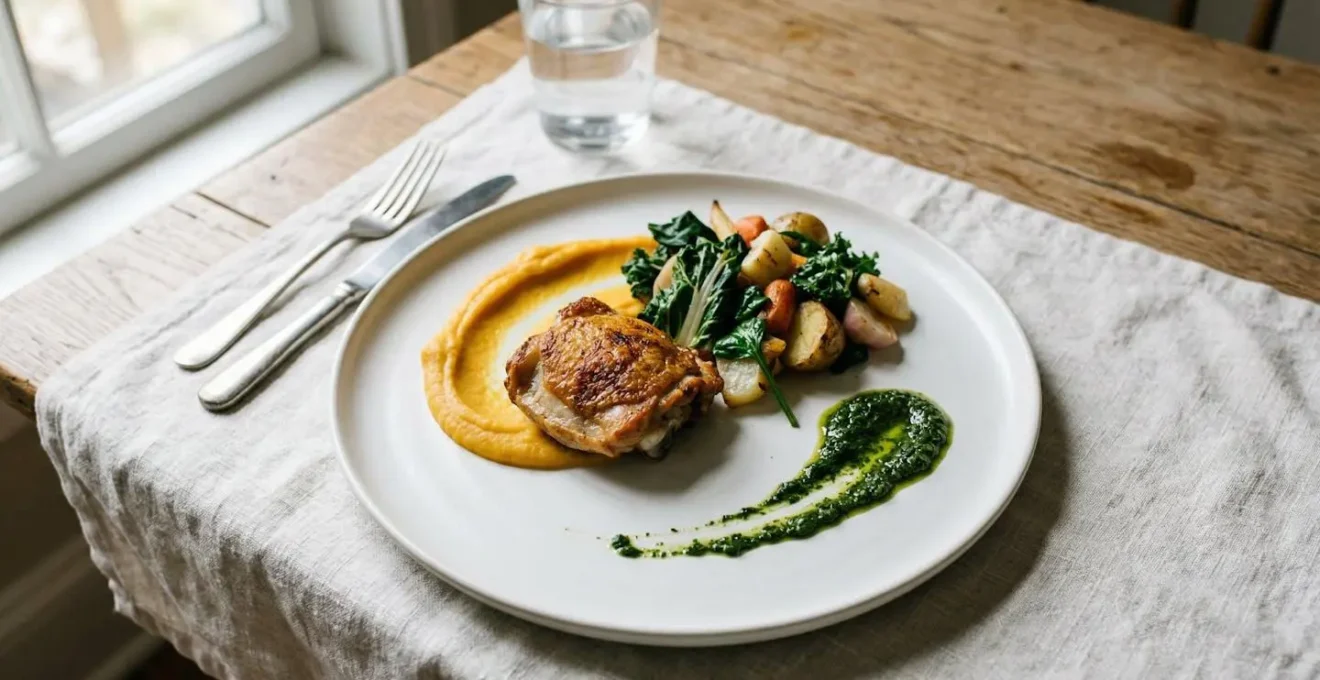
The greatest secret in fine dining is that aesthetics create flavour; by mastering visual presentation, you can make even the most humble, budget-friendly ingredients taste extraordinary.
- Deconstructing simple dishes and plating components separately with negative space dramatically increases their perceived value.
- Strategic use of sauce as a graphic element, rather than a flood, and adding fresh garnishes at the last second are key to preserving texture and signalling quality.
Recommendation: Stop thinking about decoration and start thinking about ‘sensory architecture’. Focus on one technique, like the sauce smear or creating fruit caviars, to instantly elevate your next home-cooked meal.
There’s a common frustration among ambitious home cooks: you’ve spent hours perfecting a flavourful, comforting beef stew or a creamy root vegetable soup, using simple, affordable ingredients. It tastes wonderful, but when you serve it, it just looks… brown. It’s a bowl of delicious, uninspiring sludge. The immediate reaction from your guests is polite, but it lacks the “wow” factor you secretly crave. You see chefs on television turn a carrot and a piece of chicken into a work of art, and you wonder how to bridge that gap without a brigade of staff or a pantry full of truffle oil and saffron.
Many will tell you to follow simple rules: “use an odd number of items,” “create height,” or the ever-present “garnish with a sprig of parsley.” These tips aren’t wrong, but they are platitudes. They are the equivalent of being told to “draw a face” by starting with a circle. They miss the fundamental philosophy. As a former plating specialist in fine-dining kitchens, I can tell you the secret isn’t about following rules. It’s about understanding a single, powerful principle: we taste with our eyes long before the food ever touches our lips. The aesthetic of a dish is not decoration; it is a form of visual seasoning that fundamentally alters the perception of flavour.
But what if the key wasn’t buying more expensive ingredients, but mastering the sensory architecture of the plate? This guide will teach you the professional mindset. We will explore the psychology of a clean plate, the power of negative space, the narrative of symmetry versus asymmetry, and the professional techniques for saucing and garnishing that turn budget-friendly meals into high-end experiences. Prepare to deconstruct your notions of plating and rebuild them with purpose.
This article provides a complete framework for transforming your home cooking. We will break down the core principles and provide actionable steps to immediately elevate your presentation skills. The following summary outlines the journey from basic concepts to advanced menu design.
Summary: The Professional Guide to Plating Budget Meals at Home
- Why Cluttered Plates Subconsciously Ruin the Perception of Flavor?
- How to Master the Negative Space Technique for Affordable Meat Cuts
- Which Elevates a Dish Better Between Symmetrical and Asymmetrical Plating?
- The Sauce Flooding Mistake That Destroys Intricate Garnishes Instantly
- When to Add Micro-Herbs to Prevent Wilting Before Serving Your Guests
- How to Balance Flavour Profiles Across Successive Small Plates Without Overwhelming Palates
- How to Use Agar-Agar Successfully to Create Stable Fruit Caviars at Home
- How to Design Professional 5-Course Degustation Menus For Home Dinner Parties
Why Cluttered Plates Subconsciously Ruin the Perception of Flavor?
The first principle of high-end plating has nothing to do with adding elements, but with taking them away. A cluttered, overloaded plate is the single greatest enemy of perceived value. This isn’t snobbery; it’s cognitive science. When our eyes are met with a chaotic jumble of food, our brain struggles to process the information. It perceives “visual noise” rather than distinct, appealing components. This sensory overload prevents the mind from anticipating and isolating individual flavours. In essence, a messy plate tastes muddy before it’s even eaten because the brain has already decided it’s a confusing, singular mass.
Think of it as the difference between a quiet art gallery and a crowded market. In the gallery, a single painting on a large white wall commands your full attention. You can appreciate its colour, texture, and form. In the market, thousands of items compete for your focus, and you end up seeing nothing in detail. The same is true for food. Scientific research demonstrates that attractive plate designs significantly boost the perceived tastiness and quality of the exact same food. By giving each element space, you are telling the diner’s brain: “Pay attention. This is special.”
This is why the most successful plating strategies are often based on reduction and restraint. It’s about having the confidence to let a beautifully cooked carrot stand on its own, rather than burying it under a pile of potatoes. As the celebrated Chef Charlie Palmer so eloquently put it, the rule is simple.
If you can’t see the plate, then you’ve got too much food on it.
– Chef Charlie Palmer, The Art of Plating: Creating Visual Masterpieces
This principle is your starting point. Before you learn any other technique, embrace the power of subtraction. It is the foundation of all sophisticated sensory architecture and the quickest way to make your food look, and therefore taste, more refined. Less, on the plate, is profoundly more in the mind.
Embracing this idea of ‘less is more’ is the first step toward building a dish with intention, leading directly to the active use of empty space.
How to Master the Negative Space Technique for Affordable Meat Cuts
Negative space is not empty space; it is an active design element. In fine dining, it is the silent, white canvas of the plate that makes the colours and textures of the food sing. This technique is your most powerful tool for elevating affordable meat cuts. A humble braised beef cheek or a slow-cooked lamb shank, while delicious, can look like a shapeless brown mass when served traditionally. The professional approach is flavour deconstruction: you mentally separate the dish into its core components—the meat, the sauce, the vegetable, the starch—and then reassemble them on the plate as distinct entities.
Imagine your budget-friendly stew. Instead of ladling it into a bowl, you transform it. The meat is carefully placed off-centre. The carrots are pureed into a vibrant, silky smear. The potatoes become a smooth, elegant quenelle. Each element is given its own space, separated by the pristine white of the plate. This negative space does two things: it forces the eye to appreciate each component individually, and it creates a sense of luxury and scarcity. It looks intentional, controlled, and expensive. You are no longer serving “stew”; you are presenting “Slow-Braised Beef with Carrot Essence and Potato Fondant.”
This approach highlights texture and form, which are often lost in a conventional presentation. The visual separation implies a separation of flavour, inviting the diner to experience each element before combining them. It is a guided tasting experience orchestrated by you.
As you can see in this deconstruction, the individual parts become more heroic than the whole. The glistening texture of the meat, the smoothness of the puree, the crisp edge of a roasted vegetable—all are given a chance to shine. This isn’t about being pretentious; it’s about giving your own cooking the respect and showcase it deserves. You did the work to build flavour in each component; now let the plate tell that story.
Once you’ve decided to separate the elements, the next question becomes how to arrange them on the plate for maximum effect.
Which Elevates a Dish Better Between Symmetrical and Asymmetrical Plating?
The debate between symmetrical and asymmetrical plating is not about one being “better” than the other, but about choosing the right visual language for the story your dish is trying to tell. Your choice will communicate a specific emotion to the diner. Think of symmetry as the visual equivalent of a classical sonata—it’s balanced, orderly, and conveys a sense of calm, tradition, and perfection. Asymmetry, conversely, is like modern jazz—it’s dynamic, surprising, and creates a sense of movement, excitement, and creativity.
According to culinary experts who teach the BUFF framework (Balance, Unity, Focal Point, Flow), the decision should be intentional. Symmetrical plating often works best for classic, nostalgic comfort foods. A perfectly round fishcake in the centre of a plate, or slices of roast beef fanned out in a perfect mirror image, can evoke feelings of stability and rightness. It suggests that the dish is a perfected classic. However, it can risk feeling static or mass-produced if not executed with care. Intentional asymmetry, on the other hand, is the hallmark of modern cuisine. By placing your main protein off-centre, following the “rule of thirds,” and creating a visual flow with sauce swipes and scattered garnishes, you create a path for the eye to follow. It feels more natural, artisanal, and exciting.
For budget home cooking, this choice is strategic. A hearty, affordable shepherd’s pie might be best served symmetrically to emphasize its comforting, traditional nature. A deconstructed dish using simple vegetables, however, would benefit hugely from an asymmetrical layout to highlight its creativity and make the ingredients seem more exotic and special. The following table breaks down the decision-making process.
This comparative analysis, based on a deep dive into visual food science, clarifies when to deploy each style.
| Aspect | Symmetrical Plating | Asymmetrical Plating |
|---|---|---|
| Visual Effect | Creates impression of serenity, balance, and order | Creates surprising effect, movement, and excitement |
| Perceived Quality | Often perceived as higher quality and better tasting due to association with perfection | Signals freshness, creativity, and daring culinary approach |
| Best For | Nostalgic comfort foods (mac and cheese, lasagna), classic dishes, formal settings | Modern bold-flavored dishes, tasting menus, small plates |
| Technique | Mirror-image arrangement, circular presentation, centered components | Rule of thirds, golden ratio positioning, off-center focal points |
| Risk | Can feel mechanical or ‘banquet line’ if overdone | Can read as cluttered or confusing without clear focal point |
| Budget Application | Use for hearty, affordable family meals to evoke stability | Use for ingredient-focused dishes to showcase individual textures |
Ultimately, the goal is not to randomly place items, but to make a deliberate choice. Ask yourself: what feeling do I want to evoke? Comfort and stability, or excitement and intrigue? Your answer will determine the geometry of your plate.
Whether you choose a balanced or dynamic layout, the application of sauce is a critical element that can either unify or destroy your composition.
The Sauce Flooding Mistake That Destroys Intricate Garnishes Instantly
You have perfectly cooked your protein, created a vibrant puree, and arranged them beautifully on the plate. Then comes the final step: the sauce. This is the moment where many home cooks undo all their hard work. The cardinal sin is “sauce flooding”—pouring a thin sauce or gravy over everything. This one action instantly destroys the very things you’ve worked to create: crisp textures, delicate garnishes, and the clean lines of your negative space. A crispy-skinned piece of chicken becomes soggy, a delicate micro-herb wilts into oblivion, and your carefully constructed sensory architecture collapses into a muddy pond.
In professional kitchens, pouring sauce too early or directly over crisp elements is recognized as one of the most common plating mistakes. The sauce is not a blanket; it is a deliberate, final stroke of visual seasoning. Its purpose is twofold: to add flavour and moisture, and to act as a graphic element that enhances the overall design. It should be applied with precision and control. This means moving away from the ladle and embracing tools like squeeze bottles, spoons, and even Ziploc bags with a corner snipped off.
The goal is to place the sauce strategically, where it complements rather than overwhelms. It can be pooled elegantly *under* the protein, smeared artfully across the plate, or dotted in a precise pattern. Each technique ensures that every component of the dish maintains its integrity until the diner chooses to combine them. Mastering sauce control is a non-negotiable step toward professional-level presentation.
Your Action Plan: 5 Professional Sauce Plating Techniques
- The ‘Sauce Under’ Method: Pool the sauce on the plate first, then place crispy components on top to preserve texture and prevent wilting of delicate garnishes.
- The Spoon Smear: Place a medium spoonful of sauce on the plate first, then place the back of the spoon into the sauce and smear it outward in one confident motion; never try to smear while pouring.
- DIY Squeeze Bottle Precision: Use a clean squeeze bottle (or Ziploc bag with a tiny corner snipped off) to apply sauce in controlled dots, swirls, or lines, turning it into a graphic element.
- Strategic Dotting: Use a very small amount on the end of a spoon and delicately dot sauce onto the plate in patterns, varying dot sizes for visual interest without flooding.
- The Barrier Technique: Use a thick puree as a ‘dam’ to pool thinner sauce on one side of the plate without it flooding other elements.
With your sauce perfectly placed, the final touch of freshness and colour comes from your garnish, and its timing is everything.
When to Add Micro-Herbs to Prevent Wilting Before Serving Your Guests
The final flourish, the delicate green garnish, is often what separates a “home-cooked meal” from a “cheflike composition.” But there’s a crucial difference between a clumsy sprig of curly parsley and a thoughtfully placed micro-herb. The latter signals freshness, care, and an attention to detail that elevates the entire dish’s perceptual value. The single most common mistake with these delicate greens—from micro-basil to the tender heart of a parsley leaf—is adding them too soon. They are fragile. The residual heat from a hot piece of meat or the acid in a vinaigrette will cause them to wilt and darken in minutes, turning your signal of “fresh and vibrant” into one of “tired and forgotten.”
The rule in every professional kitchen is absolute: delicate herbs and garnishes are the very last thing to touch the plate before it leaves the pass. They are not part of the cooking; they are part of the presentation. This requires having your “garnish station” ready before you plate. Wash and dry your herbs, select the most perfect leaves, and have them ready to go, perhaps with a pair of tweezers for precise placement. The dish should be fully composed, sauced, and ready for its journey to the table.
Only then, at the final second, do you add your green element. This last-moment application ensures that it reaches the diner in its most perfect state: bright, perky, and full of life. It’s a small detail, but it makes a huge psychological impact. It tells your guest that this plate was prepared for them, right now, with ultimate care. It is a gesture of respect for both the ingredient and the diner.
Observe the intentionality in this action. The use of tweezers isn’t for show; it’s for precision. It prevents the oils from your fingers from bruising the leaf and allows for placement that would be impossible with clumsy hands. This level of control, this final moment of focus, is the essence of professional plating.
This level of detail is crucial for a single plate, but when designing a multi-course menu, a new layer of complexity emerges: balancing the experience over time.
How to Balance Flavour Profiles Across Successive Small Plates Without Overwhelming Palates
Designing a multi-course tasting menu, or “degustation,” is the ultimate expression of culinary storytelling. Each plate is a chapter, and the entire meal should have a narrative arc. The biggest challenge for the home cook is not the complexity of each dish, but ensuring the diner’s palate doesn’t become fatigued or overwhelmed before the final course. Palate fatigue is real; bombarding your guests with five successive courses of rich, fatty, or intensely flavoured food will numb their taste buds and make everything start to taste the same. The key is dynamic contrast.
Professional chefs think in terms of a flavour journey. A successful menu ebbs and flows. You must strategically alternate profiles to keep the palate engaged and refreshed. Follow a rich, creamy course with something light, sharp, and acidic. Use temperature contrasts—a warm soup followed by a chilled salad. Texture is another powerful tool: after a soft, silky fish course, introduce something with a satisfying crunch. This “seesaw” approach acts as a reset button for the senses, ensuring each new dish is met with an eager and receptive palate.
Crucially, this doesn’t have to be expensive. A palate cleanser doesn’t need to be a fancy sorbet. It can be as simple and affordable as a shot of cucumber-infused water, a single frozen grape, or a tiny spoonful of a sharp lemon granita. These small, thoughtful interludes show a high level of culinary intelligence and are far more impressive than simply serving more rich food. Here are some budget-friendly strategies for sequencing your menu:
- Budget Reset Course 1: Serve a shot glass of cucumber-mint infused water (costs pennies) between rich courses to reset the palate.
- Budget Reset Course 2: Offer a single frozen grape or simple lemon zest and parsley granita as a palate cleanser.
- The Acid-Fat Seesaw: Alternate courses by flavor profile—follow a rich, fatty course (creamy potato soup) with a sharp, acidic one (simple tomato and onion salad) to keep the palate engaged.
- Ingredient Cross-Utilization: Use one core ingredient in different forms across courses (roasted tomato in one dish, tomato water in the next) to create a subtle professional flavor thread.
- Five-Color Rule: Represent meals by five colors (red, white, green, black, yellow) across courses, contributing to eye appeal and ensuring nutritional balance.
To add a truly surprising and high-end touch to this journey, modern techniques using simple ingredients can create moments of magic.
How to Use Agar-Agar Successfully to Create Stable Fruit Caviars at Home
One of the most dramatic ways to add a “wow” factor and a huge boost in perceptual value to your dishes is through a touch of molecular gastronomy. This sounds intimidating, but one of the most visually stunning techniques—creating shimmering “caviar” from almost any liquid—is incredibly simple and cheap, thanks to a seaweed-derived powder called agar-agar. For just a few pounds, you can acquire enough to elevate dozens of dishes. This technique allows you to transform a budget pantry staple, like balsamic vinegar or even soy sauce, into jewel-like pearls that burst with flavour.
The magic happens through a process called spherification, and the easiest method for home cooks is the “cold oil column” technique. Forget expensive lab equipment; all you need is a tall glass, some chilled vegetable oil, and a dropper or syringe. The basic principle is simple: you heat your chosen liquid with a small amount of agar-agar (typically a 1% ratio, so 1g of agar for 100ml of liquid), then drop the warm mixture into the cold oil. As the droplets sink through the tall column of oil, the thermal shock causes them to instantly form into perfect, stable spheres.
These pearls are a game-changer for budget plating. Imagine a simple lentil soup, visually quite plain, suddenly garnished with a spoonful of gleaming, black “caviar” made from balsamic vinegar. Or a creamy panna cotta adorned with ruby-red pearls of raspberry coulis. This technique adds an unexpected texture and a concentrated burst of flavour, turning a simple dish into a conversation piece. Follow these steps to master the method:
- Step 1: Choose budget pantry staples for savory caviars—soy sauce, balsamic vinegar, or intense vegetable broth create visually stunning pearls to garnish soups, salads, and pastas.
- Step 2: The Cold Oil Column Setup—Use a tall glass (not a shallow bowl) filled with pre-chilled vegetable oil; this method requires no special equipment and leverages gravity to create more perfectly spherical pearls.
- Step 3: Prepare agar-agar mixture with your chosen liquid (follow 1% agar ratio: 1g agar per 100ml liquid), heat until dissolved, and let cool slightly.
- Step 4: Use a dropper or syringe to drop the warm agar mixture into the chilled oil column from about 6 inches height; gravity will form spheres as they descend.
- Step 5: Strategic Application—Use this technique to add a ‘wow’ factor to otherwise visually simple, monochrome budget dishes like lentil soup or congee, not for every dish (cost-benefit analysis).
With individual techniques mastered, you are now ready to combine everything into a cohesive, professional-standard menu.
Key Takeaways
- Plating is not decoration; it’s ‘sensory architecture’ that directly influences how we perceive flavour.
- Mastering negative space and deconstructing simple dishes are the most effective ways to make budget ingredients look expensive.
- Control is everything: apply sauces with precision to avoid ‘flooding’ and add delicate garnishes at the very last second to ensure they are fresh and vibrant.
How to Design Professional 5-Course Degustation Menus For Home Dinner Parties
Designing a five-course degustation menu is the final frontier for the ambitious home cook. It’s where all the principles we’ve discussed—sensory architecture, flavour deconstruction, dynamic contrast, and visual seasoning—come together to create a singular, memorable experience. The secret to doing this on a budget is not to find five cheap main ingredients, but to choose one hero ingredient and showcase its versatility across the entire menu. This strategy, inspired by the Japanese kaiseki philosophy of ‘mottainai’ (no waste), is both economically brilliant and creatively liberating.
Pick an affordable, seasonal vegetable at its peak—a cauliflower, a butternut squash, a head of broccoli. For under £3, you have the star of your entire show. The challenge, and the genius, is to present this one ingredient in five different ways, showcasing different textures, temperatures, and flavour pairings. This creates a cohesive narrative thread that runs through the meal, demonstrating incredible culinary creativity while radically minimizing your shopping list and food waste. A universal structure can guide your menu planning:
- Course 1: ‘The Bite’—A one-bite amuse-bouche that sets the tone. Example: a tiny spoonful of cauliflower foam.
- Course 2: ‘The Liquid’—A soup or broth to warm the palate. Example: creamy cauliflower soup with a drizzle of herb oil.
- Course 3: ‘The Substance’—The main event, showcasing the hero in its most ‘meaty’ form. Example: a thick, roasted cauliflower ‘steak’ as the focal point.
- Course 4: ‘The Refresh’—A light salad or palate cleanser. Example: a sharp, pickled cauliflower salad.
- Course 5: ‘The Sweet’—A simple dessert to conclude. This could be a traditional sweet, or a clever bridge like a savory-sweet pesto made from cauliflower leaves.
This structure provides a framework for your creativity. The final professional touch is to create a “garnish station” at the start of your prep, with elements that will be cross-utilized across all five courses—toasted seeds, a single herb oil, crispy fried shallots. This not only saves time but also creates a visual theme that ties the whole meal together, making your budget menu feel like a cohesive, high-concept dining experience.
Case Study: The ‘One Hero, Five Ways’ Budget Strategy
Inspired by Japanese kaiseki philosophy, home cooks can design a professional 5-course degustation menu around one affordable, in-season vegetable (such as cauliflower, which costs under £3). The strategy showcases the hero ingredient in five different textures and forms across the menu, demonstrating culinary creativity while minimizing cost. Create a ‘garnish station’ at the beginning with cross-utilized elements (toasted seeds, herb oil, crispy fried shallots, vegetable powder) used across all five courses to create a visual theme that ties the meal together, further reducing prep time and cost.
By embracing this ‘one hero’ strategy, you are not just cooking; you are composing. You are telling a story with a single, humble ingredient, proving definitively that a limited budget is no barrier to limitless creativity.