
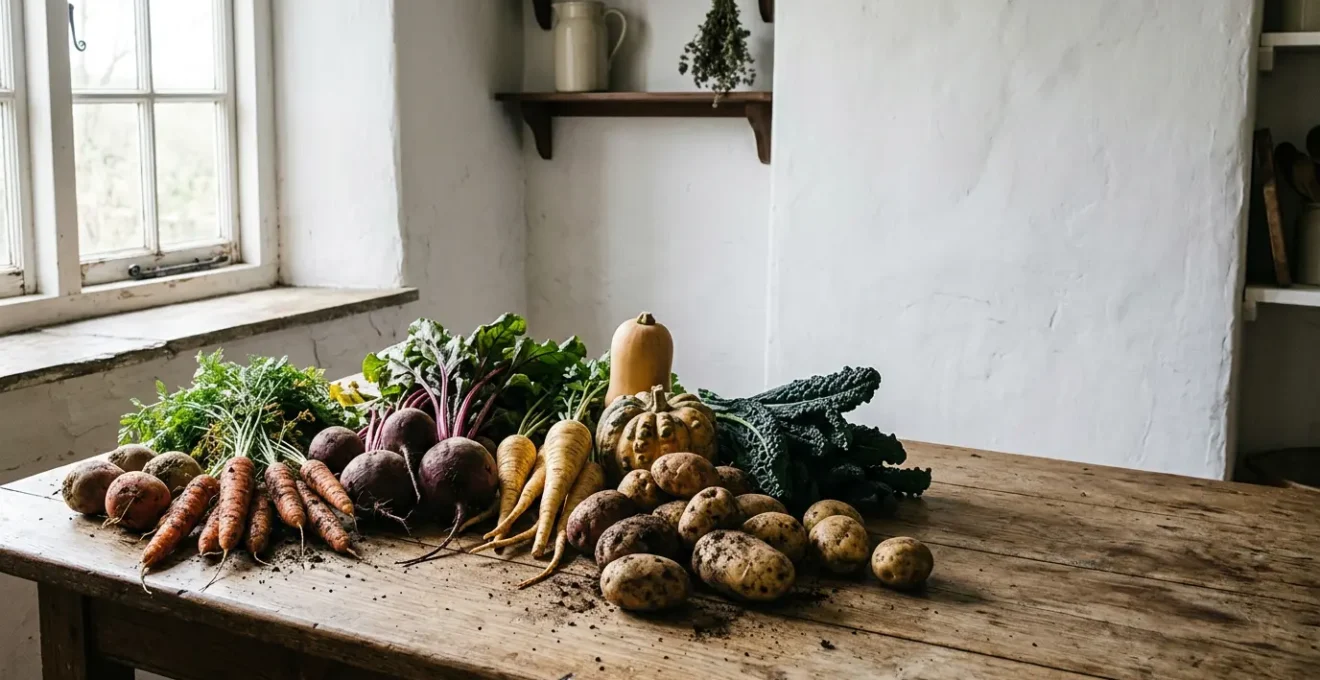
The secret to drastically cutting your food bill isn’t just “eating seasonally”—it’s adopting a “surplus-first” mindset that turns local abundance into a well-managed kitchen economy.
- Prioritise buying what’s plentiful and cheap at local markets or farm shops, then build meals around it.
- Embrace frozen British produce in winter; it often has more nutrients than expensive, air-freighted “fresh” alternatives.
- Ditch rigid recipe adherence, which leads to waste, and learn to substitute ingredients based on what you have.
Recommendation: Start by visiting your local market this weekend without a shopping list. Buy one vegetable that’s incredibly cheap and in abundance, and challenge yourself to build three different meals from it.
Watching the till total climb past £100 for a weekly shop has become a gut-wrenching, all-too-common reality for British families. You’re told the usual things: “plan your meals,” “buy own-brand,” or the vague advice to “eat with the seasons.” While well-intentioned, these tips often miss the fundamental shift in thinking required to truly make a dent in your spending. They don’t address the core problem: we’ve been taught to decide what we want to eat first, then go out and find the ingredients, regardless of cost or origin.
This approach forces us into buying strawberries in February or asparagus in December, paying a premium for produce that has travelled thousands of miles, losing flavour and nutrients along the way. But what if the secret wasn’t about rigidly following seasonal charts, but about flipping the entire process on its head? What if the key to halving your food bill was to adopt the mindset of a frugal chef: a “surplus-first” strategy? This isn’t just about saving a few quid; it’s about building a robust, delicious, and deeply satisfying kitchen economy right in your own home.
This guide will walk you through that exact strategic shift. We will dismantle the myths that keep your grocery costs high, from the false economy of imported “fresh” veg to the costly trap of rigid recipe-following. By the end, you will have a practical framework for engaging with local food systems, minimising waste, and transforming market surpluses into incredible meals, ultimately giving you more control over your budget and the quality of the food on your table.
Summary: A Practical Guide to Slashing Your Food Costs with Seasonal Eating
- Why Buying Asparagus in December Wastes Money and Harms the Environment?
- How to Build a Flexible Meal Plan Around Discounted Local Market Surplus
- Which Retains Better Nutritional Value in Winter Between Frozen Produce and Imported Fresh Veg?
- The Forced Recipe Adherence Error That Drives Up Food Waste Costs
- When to Bulk Buy British Root Vegetables for Optimal Cellar Storage
- Which Truly Benefits British Farmers Between Independent Farm Shops and Supermarket Local Aisles?
- When to Order Half a Rare-Breed Pig Direct to Maximise Cost Savings
- How to Adopt Farm-to-Table Ethics to Ensure Traceability in Your Meat Consumption
Why Buying Asparagus in December Wastes Money and Harms the Environment?
The sight of Peruvian asparagus on a supermarket shelf in the dead of winter is a perfect symbol of our broken food system. It represents a convenience that comes at an astronomical cost, both to your wallet and the planet. Out-of-season produce is expensive for a simple reason: it’s fighting nature. It either has to be grown in energy-intensive heated greenhouses or flown thousands of miles, and you are the one who foots the bill for the fuel and the complex logistics.
The environmental toll is staggering. That bunch of asparagus, air-freighted from South America, carries a colossal carbon footprint. To put it in perspective, research comparing seasonal production methods reveals that out-of-season UK greenhouse lettuce generates around 3 kg of CO2e per kilogram, whereas Spanish open-field lettuce grown in its natural season produces just 0.45 kg. That’s nearly a sevenfold increase in emissions for a simple salad green. The logic holds true across the board, from tomatoes to berries.
Beyond the carbon cost, there’s the question of quality. A vegetable’s flavour and nutritional content begin to degrade the moment it’s harvested. That asparagus spear has been on a long journey, often picked prematurely to survive the trip. Compare that to a spear of British asparagus bought from a farm shop in May, possibly picked that very morning. The taste is worlds apart. Paying more for an inferior, environmentally damaging product is a financial and culinary own goal. Resisting the temptation of year-round availability is the first, most crucial step in reclaiming your food budget.
How to Build a Flexible Meal Plan Around Discounted Local Market Surplus
The most powerful shift you can make is from “I’ll make this recipe, so I need these ingredients” to “This is what’s abundant and cheap, so what can I make with it?” This is the ‘surplus-first’ mindset. It means heading to your local market, greengrocer, or farm shop with an open mind, not a rigid list. Your mission is to spot the gluts: the crates of knobbly carrots, the mountain of cavolo nero, the slightly-too-ripe tomatoes being sold off at the end of the day. This is where the real savings are made.
Once you’ve secured your haul, the next step is to process it strategically. Not everything needs to be eaten immediately. Adopting a simple tiered approach prevents waste and builds a larder you can cook from all week. This transforms a chaotic pile of vegetables into an organised “kitchen economy.” It requires a bit of planning upfront, but it pays dividends in time and money saved later. Instead of letting that bag of spinach wilt in the back of the fridge, you have a clear plan for its use.
This method frees you from the tyranny of the weekly shop. You might pop to the market twice a week for 20 minutes to grab the best deals, rather than doing one huge, expensive supermarket run. Your meal plan becomes a fluid, adaptable guide rather than a strict set of rules. It’s a more intuitive, creative, and ultimately cheaper way to cook and eat, connecting you directly to the rhythm of the land and the value of real, fresh food.
Your Action Plan: Auditing Your Market Haul
- Immediate Use (within 48 hours): Identify and prioritise the most perishable items. This includes delicate salad leaves, soft herbs, berries, and soft fruits. Plan your next few meals around them.
- Weekly Cooking (process within 5-7 days): Inventory the semi-perishables. This tier includes root vegetables like carrots and parsnips, brassicas like broccoli and cabbage, and squashes. These form the backbone of your week’s meals.
- Preservation (process now for later): Target the gluts. If you have a huge amount of one item, preserve it immediately. Blanch and freeze greens, turn a glut of tomatoes into a big batch of freezer sauce, or pickle beetroots and cucumbers.
- Flavour Base Stocktake: Assess your onions, garlic, and hardy herbs (rosemary, thyme). These are the versatile foundations of most dishes and should be stored correctly for maximum longevity.
- Meal Sketching: With your inventory organised, sketch out 3-4 meal *ideas* (e.g., “Root Veg Stew,” “Kale & Potato Soup”) rather than rigid recipes. This provides direction while allowing for flexibility.
Which Retains Better Nutritional Value in Winter Between Frozen Produce and Imported Fresh Veg?
There’s a pervasive myth that “fresh is always best,” leading many to spend a fortune on sad-looking, air-freighted vegetables in winter. The truth, however, is that the frozen food aisle is one of a frugal chef’s greatest allies. When it comes to nutritional value, a British-grown pea frozen within hours of picking is almost always superior to a “fresh” one that has spent a week travelling from Kenya or Egypt.
This is because many vitamins, particularly Vitamin C, are highly volatile. They begin to degrade from the moment of harvest, a process accelerated by light and heat. Produce destined for long-haul travel is often picked unripe and then sits in transit and storage for days. By the time it reaches your kitchen, a significant portion of its nutritional goodness has vanished. For instance, nutritionist research demonstrates that fresh spinach can lose up to 75% of its Vitamin C after just two days of storage at room temperature, while asparagus and broccoli can lose up to 80%.
The process of flash-freezing, on the other hand, locks in nutrients at their peak. Vegetables are picked at their ripest and frozen rapidly, preserving their vitamins and minerals with minimal loss.
As this close-up shows, the rapid freezing process forms tiny ice crystals that minimise damage to the vegetable’s cellular structure, effectively pressing pause on nutrient degradation. So, in winter, when local fresh options are limited, confidently reach for British-grown frozen produce. It’s cheaper, reduces food waste (you only use what you need), and is often more nutritious than its tired, well-travelled “fresh” counterparts. It’s a simple switch that benefits your health and your bank balance.
The Forced Recipe Adherence Error That Drives Up Food Waste Costs
One of the biggest hidden costs in any household budget is the food that ends up in the bin. We often blame this on poor planning or buying too much, but a major culprit is our rigid adherence to recipes. You find a recipe online that calls for 10g of fresh tarragon, so you buy a whole bunch, use a tiny amount, and the rest turns to a slimy green mush in the fridge drawer. Sound familiar? This is the “forced recipe adherence” error, and it’s a direct drain on your finances.
The scale of the problem is enormous. In the UK, food waste is a significant financial burden on families. Shockingly, WRAP data reveals that the average UK household wastes food costing an estimated £470 every single year. A huge portion of this is perfectly edible food that is simply not used in time. It’s the half a leek, the wilting celery, and the quarter-jar of sauce bought for a single meal.
The solution is to cultivate recipe flexibility. Think of recipes as guidelines, not gospel. That recipe calling for tarragon? If you have fresh parsley or dried herbs, use those instead. Does it need a leek? An onion will probably do the job just fine. Learning to make simple, smart substitutions based on what you *already have* is a superpower for saving money. It forces you to get creative and to understand the *function* of an ingredient in a dish (e.g., “this adds an aromatic base,” “this provides a fresh, herby lift”). This approach not only slashes your food waste but also makes you a more confident and intuitive cook.
When to Bulk Buy British Root Vegetables for Optimal Cellar Storage
Come late autumn, British farms are overflowing with incredible root vegetables: potatoes, carrots, parsnips, swedes, and beetroots. This is the prime time to embrace strategic bulk buying. When supply is at its peak, prices plummet. Buying a 25kg sack of potatoes directly from a farm or a large bag of carrots from the market can be astonishingly cheap compared to buying them in small supermarket packets week after week.
However, buying in bulk is only cost-effective if you can store it properly to prevent waste. You don’t need a sprawling ancestral root cellar; a cool, dark, and well-ventilated space like a garage, a shed, or even a protected corner of a balcony can work wonders. The key is preparing the vegetables correctly for their slumber. This process, known as curing, involves toughening up their skins to heal any harvest wounds and prevent rot, ensuring they last for months, not weeks.
Proper preparation is a simple but vital step that our grandparents understood well. It’s a small investment of time that pays off by giving you a larder of cheap, delicious vegetables to see you through the winter.
This careful handling is the difference between a sack of potatoes lasting until March and a mouldy mess by Christmas. Before storing, follow these simple but crucial steps:
- Cure tough-skinned veg: Allow potatoes, winter squash, and onions to sit in a warm, dry place for a week or two to harden their skins.
- Don’t wash: Brush off excess dirt but avoid washing root vegetables. The thin layer of soil acts as a natural protective barrier against rot.
- Handle with care: Avoid bruising the vegetables, as any damage will be a starting point for decay.
- Ensure good airflow: Store in slatted wooden crates, hessian sacks, or cardboard boxes with holes punched in them. Never use plastic bags, which trap moisture.
Which Truly Benefits British Farmers Between Independent Farm Shops and Supermarket Local Aisles?
As you shift your buying habits, a question naturally arises: where should you spend your money to have the most impact? You see “local” produce in both the big supermarkets and at the independent farm shop down the road. While both might seem like good choices, the reality for the farmer is starkly different. This is a classic case of shortening the value chain.
When you buy from a large supermarket, even from their “local” section, the farmer receives only a small fraction of the final price. The rest is absorbed by the supermarket’s own margins, distribution costs, central packing houses, and marketing. The supermarket holds all the power, often dictating prices and imposing strict cosmetic standards that lead to immense food waste at the farm level (the infamous “wonky veg”). While it’s better than buying imported, it’s a system that still puts a huge squeeze on the producer.
In contrast, when you buy directly from an independent farm shop, a farmers’ market, or through a veg box scheme, you are putting a significantly larger percentage of your money directly into the farmer’s pocket. You are cutting out several middlemen. This direct relationship does more than just provide fairer pay; it gives the farmer financial stability, allows them to grow a more diverse range of crops (not just what the supermarket demands), and fosters a resilient local food economy. The food is often fresher, and you get access to varieties and heritage breeds you’ll never see in a chain store. Choosing the farm shop over the supermarket’s local aisle is a powerful vote for the kind of food system you want to support.
When to Order Half a Rare-Breed Pig Direct to Maximise Cost Savings
Applying the “surplus-first” and “value chain shortening” principles to meat can lead to the most dramatic savings of all. The idea of buying half a pig or a quarter of a cow might sound extreme, but it’s a traditional, highly efficient practice that is making a comeback. The best time to do this is typically in the autumn and early winter, when smallholders and farms are managing their livestock numbers before the costly winter feeding period begins.
The economics are compelling. When you buy meat in individual supermarket packs, you’re paying a premium for the butchery, packaging, and retail markup on each specific cut. Buying in bulk direct from a farm, you pay a single price per kilogram for the entire carcass weight. This means you get prime cuts like tenderloin and belly for the same average price as shoulder or mince. The overall cost per kilo can be 30-50% lower than buying the equivalent cuts separately. For a £100 weekly budget, investing £150-£200 in a half pig can supply your family with high-quality, ethically-reared meat for several months, drastically reducing your weekly spend thereafter.
To make it work, you need two things: freezer space and a plan. You’ll receive a box containing a huge variety of cuts: roasting joints, chops, bacon, sausages, mince, and even the hocks and bones. The key is to see this not as a pile of meat, but as a larder of potential meals. The bones become stock, the fat can be rendered into lard for roasting, and even the offal can be used for nutrient-dense dishes like pâté. It is the ultimate exercise in nose-to-tail eating, eliminating waste and maximising value in a way that is simply impossible when buying from a supermarket.
Key takeaways
- Stop buying out-of-season produce; it’s expensive, less tasty, and environmentally damaging.
- Adopt a “surplus-first” mindset: buy what’s abundant and cheap at local markets, then plan meals around it.
- Embrace British-grown frozen vegetables in winter as a nutritious and cost-effective alternative to imported “fresh” goods.
How to Adopt Farm-to-Table Ethics to Ensure Traceability in Your Meat Consumption
Moving towards a seasonal, local food model culminates in one of the most important aspects: knowing where your food comes from. This is never more critical than with meat. The “farm-to-table” ethic isn’t just a trendy restaurant concept; it’s a practical framework for every family to ensure the quality, welfare standards, and traceability of the meat they consume. When you buy anonymous, plastic-wrapped meat from a supermarket, you lose all connection to its origin.
Adopting this ethic means actively seeking out producers you can trust. Start by asking questions. Talk to your local butcher: where do they source their meat? Can they tell you about the farm? Visit farmers’ markets and speak directly to the people who raise the animals. A producer who is proud of their work will be happy to talk about their farming practices, the breed of their animals, and how they are raised. This transparency is the hallmark of a high-quality, ethical system. It is your best guarantee against the low-welfare, industrialised farming that dominates the mainstream supply chain.
This approach isn’t about perfection; it’s about progress. It’s about consciously shifting your spending, even for one or two meals a week, towards a source you can trust. By shortening that supply chain, whether by buying a quarter of a lamb from a local farm or simply choosing the butcher who knows his suppliers by name, you are investing in a better system. You get superior flavour and the peace of mind that comes from knowing the story behind your food, transforming a simple purchase into a meaningful connection with your local food landscape.
To put these principles into practice and transform your household budget, the next logical step is to start building relationships with your local producers and truly understand the value they offer.