
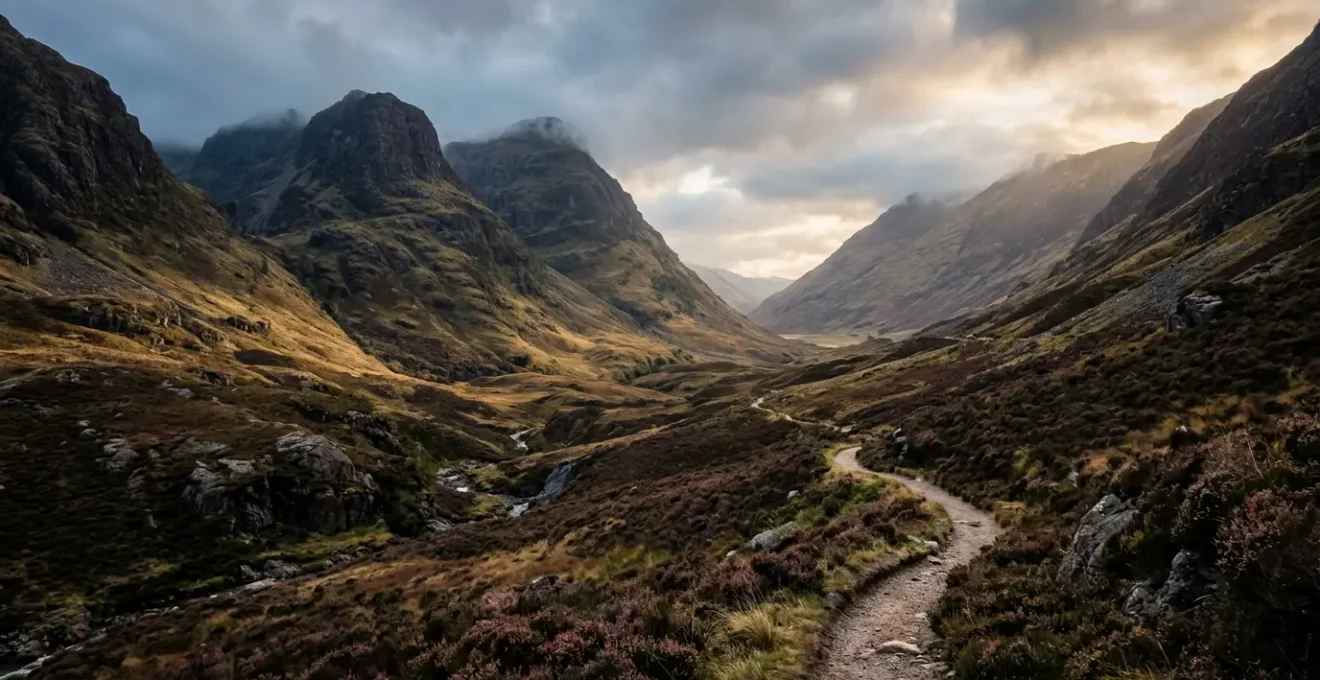
The key to an authentic Highlands trip isn’t a secret list of places, but a strategic shift in how you plan.
- True exploration comes from “itinerary inversion”—building your journey around authentic, remote accommodations, not forcing them into a pre-set tourist route.
- Lasting memories are made by engaging with “heritage-keeper” businesses and using modern mapping tools to uncover trails that guidebooks miss.
Recommendation: For your next trip, book your independent guesthouse or B&B at least six months in advance, then build your daily itinerary around that single authentic anchor point.
The image is a familiar one: a queue of cars snaking towards a single viewpoint on the Isle of Skye, everyone trying to capture the exact same photograph. For the discerning UK traveller seeking genuine rural escape, this is the very definition of a holiday failure. The common advice—to simply “travel off-season” or “book early”—barely scratches the surface of a problem that has become deeply embedded in the modern travel psyche. We are conditioned to follow the signposted routes, the “Top 10” lists, and the recommendations of guidebooks that have, by their very nature, created the tourist traps we seek to avoid.
This endless cycle of visiting crowded honeypots leaves little room for serendipity or true connection with the landscape. But what if the entire approach is flawed? What if the solution isn’t about finding a better list of “secret” places, but about fundamentally changing the methodology of how we plan our escape? The real secret to an authentic Highland holiday lies not in the *destinations* you choose, but in the *framework* you use to build your journey. It involves a pragmatic shift from following the crowd to building a trip based on logistical independence and cultural context.
This guide will not give you another list of overcrowded castles. Instead, it provides a strategic framework for the independent traveller. We will deconstruct why standard guidebooks often fail, explore a methodology for unearthing local trails, analyse the trade-offs between different landscapes, and pinpoint the critical booking mistakes that lock you into the tourist circuit. Ultimately, you will learn how to build an itinerary from the ground up, using authentic local anchors as your guide, ensuring your next trip to the Highlands is a genuine exploration, not a box-ticking exercise.
To help you navigate this strategic approach, the following article breaks down the essential components for planning your authentic escape. Each section addresses a critical question, providing the tools and mindset needed to sidestep the crowds and discover the real heart of the Highlands.
Table of Contents: The Independent Traveller’s Guide to the Scottish Highlands
- Why Relying on Standard Guidebooks Ruins 80% of Highland Escapes?
- How to Find Hidden Local Trails in Cornwall Safely
- Which to Choose Between Coastal Treks and Inland Paths for a 7-Day UK Walking Holiday?
- The Booking Mistake That Traps Peak Season Travellers in Crowded Hotspots
- When to Book Independent Guesthouses to Secure £50 Nightly Rates
- How to Use Non-Verbal Cues Successfully When Ordering Food in Rural Markets
- When is the Least Disruptive Season to Observe Nesting Sea Turtles Safely?
- How to Respect Indigenous Cultural Heritage When Visiting Remote Global Communities
Why Relying on Standard Guidebooks Ruins 80% of Highland Escapes?
The fundamental problem with standard guidebooks is that they are victims of their own success. By identifying and promoting a finite list of “must-see” locations, they concentrate visitor traffic into predictable, easily overwhelmed hotspots. This isn’t a minor issue; it’s a systemic one that fundamentally alters the travel experience. The sheer volume of tourism, driven by this concentrated focus, has reached a critical point. With a staggering 17.5 million overnight visitors to Scotland in 2019—a rate of 3.2 visitors per capita compared to the European average of 1.4—the pressure on popular sites is immense.
This concentration doesn’t just lead to crowded car parks and queues; it actively damages the relationship between tourists and local communities. The experience of “discovery” is replaced by the reality of consumption, turning vibrant local areas into congested corridors. This tension is no longer a quiet murmur but a vocal frustration. As one Scottish media outlet reported, the situation has become so acute that it has provoked a direct backlash from residents.
Popular spots on the North Coast 500 route saw traffic chaos last summer, and locals in some Highland villages have started ‘No More Tourists’ Facebook groups.
– Cumbernauld Media, Scotland Tourism Record Boom 2024
When you follow a standard guidebook, you are not just visiting a place; you are participating in a well-trodden, high-impact system that often works against the principles of authentic travel. The path to a genuine escape requires a deliberate break from this system, moving away from prescribed itineraries and towards a more independent, research-led approach. It means accepting that the most rewarding experiences are often those that are not listed in any top-ten article.
How to Find Hidden Local Trails in Cornwall Safely
The principle of finding hidden trails, often romanticised in discussions about walking holidays in places like Cornwall, is a practical skill that can be systematically applied to the Scottish Highlands. The key is to move beyond consumer-grade maps and tap into resources curated by those who walk the paths daily. This means trading the glossy, simplified maps found in guidebooks for more detailed and locally-informed tools. The goal is to equip yourself for self-reliant navigation, transforming your perspective from that of a tourist to that of an explorer.
This transition requires both a mindset shift and the right tools. A traditional compass and a detailed Ordnance Survey map are not just nostalgic accessories; they are fundamental instruments for understanding the terrain in a way that a GPS app cannot replicate. They encourage you to read the landscape, interpret contours, and make informed decisions, fostering a deeper connection with your surroundings.
Fortunately, technology is now being used to democratise this local knowledge. Instead of making trails more crowded, projects are underway to map and share paths that have long been known only to locals, providing a powerful alternative to the overwhelmed “honeypot” trails. A prime example is the initiative by Ramblers Scotland, which demonstrates how to do this on a national scale.
Case Study: The Ramblers Scotland Digital Mapping Project
In a direct response to the need for more diverse walking routes, Ramblers Scotland developed a comprehensive digital map that has unveiled nearly 450 previously unmarked trails. Since 2019, over 100 volunteers have added hundreds of paths not shown on standard Ordnance Survey maps, totalling thousands of miles of authentic routes. As detailed in a report by The Scotsman, this interactive map includes crucial data on path conditions, surfaces, and potential obstacles, all verified by experienced walkers. It provides a blueprint for how to safely access authentic trails beyond the guidebook’s limited scope.
By leveraging tools like the Scottish Paths Map and complementing them with traditional map-and-compass skills, you can build an itinerary of walks that are not only quieter but also richer in local character. This is the practical application of seeking authenticity: using better data to make better choices.
Which to Choose Between Coastal Treks and Inland Paths for a 7-Day UK Walking Holiday?
The choice between a coastal and an inland walking holiday in the Highlands is not merely a question of scenery; it’s a choice between two distinct experiential narratives. Your decision should be guided by the kind of story you want to inhabit for a week. Are you seeking the elemental drama of cliffs and sea, a narrative of resilience against wild weather? Or are you drawn to the contemplative stillness of ancient forests and hidden lochs, a story of solitude and deep-seated history? Understanding this distinction is the first step in crafting a truly personal and satisfying itinerary.
The coastal routes, especially those tracing sections of the North Coast 500, offer a powerful connection to Scotland’s seafaring and Viking heritage. The paths are exposed, the weather is a constant, dramatic character, and the views are often vast and epic. This is a landscape that feels raw and untamed. In contrast, the inland paths of the Cairngorms or the glens, like Glen Affric, offer a more sheltered, immersive experience. Here, the narrative is one of Jacobite history, of ancient Caledonian forests, and of the quiet majesty of red deer and golden eagles. The solitude can be profound.
To make a pragmatic decision, it’s crucial to compare the practical realities of each option. Factors like weather exposure, potential visitor density even in “remote” areas, and logistical accessibility will significantly shape your experience. The following comparison breaks down these key dimensions.
| Dimension | Coastal Treks (e.g., North Coast 500 sections) | Inland Paths (e.g., Glen Affric, Cairngorms) |
|---|---|---|
| Experiential Narrative | Elemental drama: Viking heritage, resilience, wild weather, seafaring history | Solitude & stillness: Jacobite history, hidden lochs, ancient Caledonian forest |
| Weather Exposure | High—dramatic and changeable, strong coastal winds | Moderate—sheltered glens, though high peaks exposed |
| Visitor Density (Peak Season) | Higher on NC500 sections and popular coastal spots | Lower in remote glens away from main tourist hubs |
| Accessibility | Often requires linear hiking or multiple accommodations | Hub-and-spoke model viable from central glen bases |
| Wildlife Viewing | Seabirds, seals, coastal flora | Red deer, pine martens, golden eagles, woodland birds |
| Best Suited For | Adventurers seeking dramatic vistas and elemental connection | Seekers of contemplative solitude and forest immersion |
Ultimately, there is no “better” choice. The right path is the one that aligns with your personal definition of an escape. By considering the experiential narrative you wish to pursue, you move beyond a simple choice of geography and begin to consciously design a more meaningful adventure.
The Booking Mistake That Traps Peak Season Travellers in Crowded Hotspots
The single most common and costly mistake travellers make is planning their route first and then trying to find accommodation along it. This conventional approach is the primary reason people end up in crowded, overpriced hotspots. During peak season, when a total of 1.79 million overnight tourism visits put immense pressure on the Highlands’ infrastructure, the best independent guesthouses and unique B&Bs in desirable, quiet locations are booked out months in advance. By the time you have your route planned, your only remaining options are often generic hotels in busy towns or last-minute, inflated listings on major booking platforms.
This forces you into the very tourist ecosystem you’re trying to escape. You end up starting and ending your days in crowded hubs like Fort William or Portree, competing for restaurant reservations and navigating tour bus schedules. The solution is a simple but powerful strategic shift: itinerary inversion. You must book your accommodation *first*, and then build your daily itinerary *around* these authentic anchor points. Find a unique, highly-rated guesthouse in a “second-tier” village—one that is 20-30 minutes away from a major hub—and use it as your base for exploration.
This approach gives you logistical freedom. You can visit popular sites early in the morning or late in the afternoon, completely avoiding the 10 AM to 2 PM rush hour created by tour buses and day-trippers. Your evenings are spent in a genuinely quiet, local setting, not a bustling tourist town. To execute this strategy effectively, you need a disciplined pre-booking research process.
Your Action Plan: The Pre-Booking Research Framework
- Identify Anchor Points: Use direct property websites and local tourism association sites—not just major booking platforms—to identify 3-4 unique, remote guesthouses or B&Bs in second-tier villages at least 20 minutes from major hubs.
- Check for Event Conflicts: Cross-reference your potential accommodation locations with local event calendars. Check for Highland Games schedules, agricultural shows, and music festival dates to avoid unintentional overlap and inflated prices.
- Book First, Plan Second: Secure your chosen accommodation 6+ months ahead for peak season. Only then should you begin building your daily itinerary around these fixed, authentic anchor points.
- Contact Directly: Always contact properties directly by phone or email. Inquire about mid-week discounts, shoulder-season rates, or package deals that are often unavailable on third-party booking platforms.
- Map Your Radius: Before confirming, map the walking and driving distances from your chosen accommodation to your key points of interest. This ensures you can access highlights on your own schedule, strategically avoiding the tour-bus rush hours.
By adopting this disciplined, accommodation-first approach, you are no longer a passive participant in the tourist trail. You are actively designing an itinerary that prioritises authenticity and independence from the very start.
When to Book Independent Guesthouses to Secure £50 Nightly Rates
Securing a room in a characterful independent guesthouse for a rate around £50 per night is the holy grail for many budget-conscious, authenticity-seeking travellers. While this price point is increasingly challenging to find during the peak months of June to August, it is not impossible. It simply requires a strategic approach to timing, moving beyond the simple “book early” mantra to a more nuanced understanding of seasonal and weekly pricing tiers.
The most significant factor is embracing the “shoulder” and off-peak seasons. As VisitScotland’s accommodation guidance confirms, the period from November to March offers demonstrably lower rates. More than just cost savings, travelling during this time provides a fundamentally different experience: attractions are quieter, landscapes are more dramatic under winter light, and the sense of solitude is greatly enhanced. Within this off-peak window, targeting mid-week breaks (typically Sunday to Thursday) can yield even better availability and pricing as you avoid the weekend getaway rush from nearby cities.
However, price is not the only variable. The type of accommodation plays a crucial role. Independent B&Bs and guesthouses are often the key to unlocking this value, but it’s important to approach them with realistic expectations. As the national tourism body notes, there is a wide spectrum of quality and cost.
B&Bs and guest houses can often be more affordable than hotels, particularly for short stays. However prices vary depending on location, season, facilities and quality of the B&B.
– VisitScotland, Bed and Breakfasts & Guest Houses in Scotland
The “£50 rule” therefore becomes a function of three variables: season, day of the week, and direct booking. By targeting a Tuesday night in April or October and contacting a guesthouse owner directly to inquire about their best rate (bypassing the commission-based booking platforms), you dramatically increase your chances of hitting that coveted price point. This is strategic booking in practice: understanding the market levers and using them to your advantage to secure not just a cheaper stay, but a more authentic one.
How to Use Non-Verbal Cues Successfully When Ordering Food in Rural Markets
Engaging with local food culture is one of the most direct routes to an authentic experience, and nowhere is this more true than at a rural farmers’ market in the Highlands. Here, away from the impersonal nature of supermarkets, the transaction is as much about human connection as it is about commerce. However, for a visitor, navigating a bustling market stall with unfamiliar products and thick local accents can be intimidating. This is where the successful use of non-verbal cues becomes a vital skill, transforming a potentially awkward encounter into a memorable exchange.
The foundation of this interaction is respect and genuine curiosity. Before you even speak, your body language communicates your intent. Instead of rushing, take a moment to observe the stall. Show interest in the products. Make eye contact with the producer and offer a simple, warm smile. This small gesture immediately signals that you see them as a person, not just a vendor, and that you appreciate their craft. When it’s your turn, pointing is a universal and perfectly acceptable tool. Point clearly at the item you’re interested in—be it a rustic loaf of bread, a hand-pressed cider, or a wheel of artisan cheese—and raise your eyebrows in a questioning manner. This is a clear, unambiguous request for information.
Listen carefully to the response, even if you don’t understand every word. The producer’s tone and gestures will often convey the most important information. A nod, a thumbs-up, or a gesture indicating a sample can bridge any language gap. When you make a purchase, handle the money clearly and make a point of saying “thank you” (a simple “cheers” is universally understood and appreciated in the UK). These small, deliberate actions—smiling, pointing, listening, and showing gratitude—are the non-verbal cues that build rapport. They demonstrate respect for the producer’s work and open the door to a more meaningful connection, often leading to a recommendation for a local secret or a story behind the food that you would never find in a guidebook.
When is the Least Disruptive Season to Observe Nesting Sea Turtles Safely?
The principles of ethical wildlife observation are universal. While the question of observing nesting sea turtles might seem specific to exotic, faraway shores, the core ethics—maintaining distance, minimising disturbance, and respecting breeding cycles—are directly and critically applicable to observing the iconic wildlife of the Scottish Highlands. Applying this “do no harm” framework is not just good practice; it’s essential for ensuring the long-term health of the ecosystems you have come to admire.
The key is to shift your perspective from being a passive consumer of wildlife sightings to an active, responsible observer. This means educating yourself before you even leave your accommodation. The “least disruptive season” is a dynamic concept that changes for each species. For ground-nesting birds like puffins and terns on coastal cliffs, the peak breeding season from April to July is an incredibly sensitive time. For red deer, the autumn rut (September-October) is a spectacular but volatile period where stags are aggressive and easily disturbed. The first principle, therefore, is to consult what we can call the “Ranger’s Window”—the real-time guidance provided by local experts.
Before any wildlife-focused excursion, your first action should be to check the websites and social media feeds of organisations like RSPB Scotland, the National Trust for Scotland, or local wildlife trusts. They provide up-to-the-minute information on sensitive areas, temporary path closures, and best-practice viewing guidelines. This proactive research allows you to plan your visit for a time and place that is least disruptive. The other core principles follow from this foundation of respect:
- Maintain Distance: The “20-metre rule” for turtles translates directly. Stay at least 20-50 metres away from nesting seabirds, seal haul-outs, or rutting deer. A good pair of binoculars is your most ethical tool; it allows you to get a close-up view without causing stress to the animal.
- Silence and Patience: Move slowly, speak in low voices, and wear muted colours. Avoid flash photography at all costs. The most rewarding sightings often come to those who find a discreet spot and simply wait patiently.
- Leave No Trace (Plus): This goes beyond simply taking your litter home. It means sticking rigorously to designated paths to avoid trampling delicate vegetation or disturbing unseen nests. It means actively removing litter you find, even if it isn’t yours.
By applying the same rigorous ethics to observing a puffin colony as one would to a turtle nesting beach, you contribute to the preservation of the very wildness that makes the Highlands so special.
Key Takeaways
- Ditch generic guidebooks and instead leverage specialised tools like the Ramblers Scotland digital map for authentic trail discovery.
- Practice “Itinerary Inversion”: secure your remote, independent accommodation first (6+ months in advance), then build your route around these authentic anchor points.
- Engage ethically with the Highlands by supporting “heritage-keeper” businesses that preserve local culture and applying a strict, low-impact code of conduct to all wildlife observations.
How to Respect Indigenous Cultural Heritage When Visiting Remote Global Communities
The principle of respecting indigenous cultural heritage is not an abstract concept reserved for trips to the Amazon or the Arctic; it is a crucial and immediate responsibility when visiting the Scottish Highlands, the heartland of Gaelic culture. For an authentic experience, this means moving beyond the superficial consumption of tartan souvenirs and actively engaging with Gaelic as a living, breathing part of the landscape and economy. It is a tangible interest for many, as the Scotland Visitor Survey 2023 findings reveal that 28% of visitors felt learning about Gaelic culture enhanced their visit, a figure rising to 46% for long-haul travellers.
Respectful engagement starts with recognition. The bilingual road signs are not just for show; they are a statement of cultural identity. Take a moment to look at them, to recognise the Gaelic names, and to appreciate that you are in a place with a linguistic heritage that predates English by centuries. This simple act of observation is the first step in seeing the culture as present and vital, not just a historical footnote.
The most powerful way to show respect, however, is through your economic choices. This means consciously directing your spending towards what can be termed “heritage-keeper” businesses. These are enterprises where the act of commerce is intrinsically linked to the preservation of culture. They are the antithesis of mass-produced souvenir shops. By supporting them, you are not just a tourist; you are a temporary patron of cultural sustainability.
Case Study: Economic Respect Through Heritage-Keeper Businesses in the Hebrides
The Outer Hebrides, a Gaelic heartland, provides a clear model for how this works. When you purchase authentic Harris Tweed, you are supporting an industry protected by legislation that requires weavers to be based in the Hebrides and use traditional methods. When you visit a community-run venue like An Taigh Cèilidh (‘The Gaelic café’) or attend the Hebridean Celtic Festival, your money directly funds spaces where the language and music thrive. This is a world away from buying a generic “Made in China” tartan scarf. By consciously choosing these heritage-keepers, travellers become active participants in ensuring that Gaelic traditions remain economically viable and central to the identity of the region for generations to come.
This is the essence of respectful tourism: understanding that your travel decisions have a real-world impact. By choosing to support businesses that are guardians of heritage, you move from being a passive observer to an active, positive contributor to the culture you have come to experience.
Your next authentic Highland adventure doesn’t start with a destination, but with a decision. It begins with the choice to abandon the well-trodden path and adopt a more thoughtful, strategic framework for your planning. Begin your research today by seeking out those remote anchor points and heritage-keeper businesses—your future self, away from the crowds and deeply connected to the real Scotland, will thank you.