
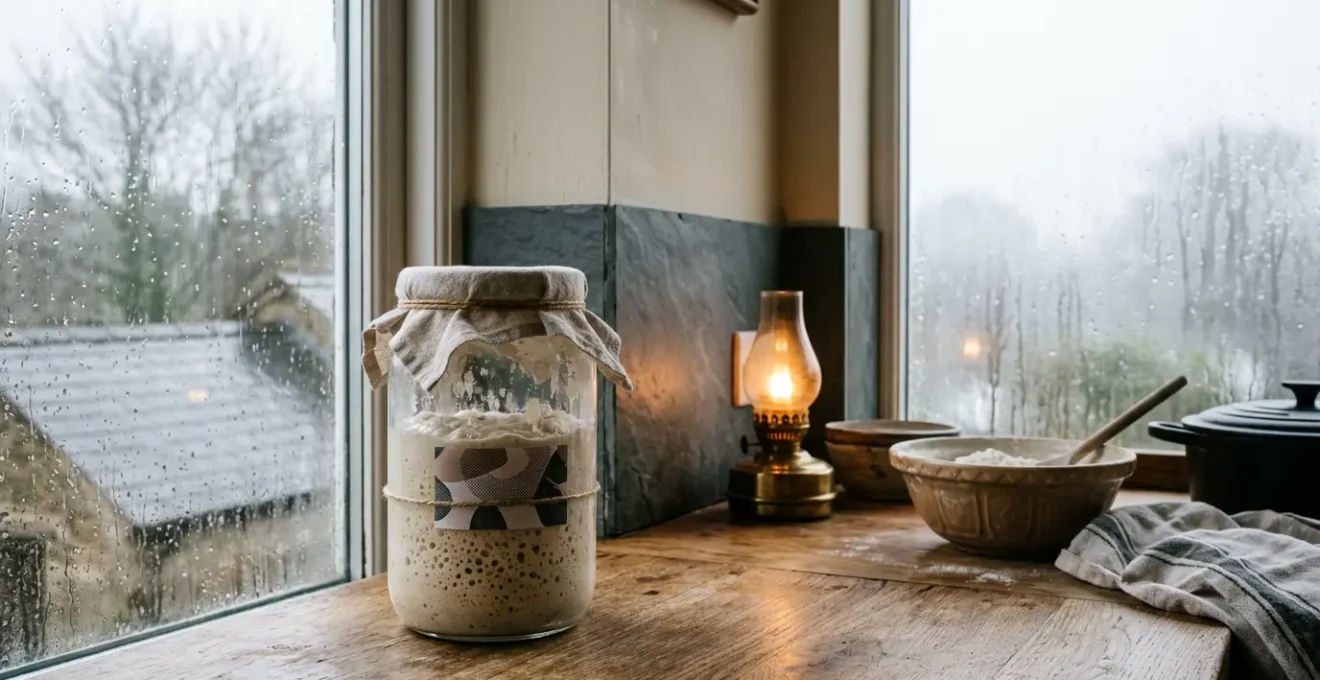
In summary:
- Cold British winters stress your sourdough starter, making it sluggish, acidic, and smelling of acetone.
- The key is to stop fighting the cold and start understanding the starter’s needs as a living microbial ecosystem.
- Diagnose stress signals (like smells) to understand if your starter is hungry, cold, or suffocating in acid.
- Engineer a stable micro-climate (24-26°C) using zero-cost methods like an oven with the light on.
- Feed it the right diet (rye flour is a superfood) with clean, chlorine-free water and adjust feeding ratios for the cold.
There’s a familiar sense of dread for the British baker when the clocks go back. The air grows damp, a persistent chill seeps into the kitchen, and the once-bubbly sourdough starter on the counter slows to a crawl. It becomes sluggish, refusing to rise with its usual vigour, and sometimes emits a sharp, worrying scent of acetone. Many guides will tell you to simply “find a warm spot” or “be patient,” but this advice often falls short in a drafty house where consistent warmth is a luxury.
This frustration leads many to believe their starter has died, or that winter baking is an impossible dream. We’re told to use proofer boxes or accept defeat until spring. But what if the problem isn’t just the cold, but our misunderstanding of what our starter is trying to tell us? What if the secret isn’t just about applying brute-force heat, but about becoming a ‘microbial whisperer’ who can read the subtle cues of this living culture and respond to its needs with precision and care?
Treating your starter like a temperamental pet, rather than a simple flour-and-water paste, is the key to unlocking its potential even on the darkest winter days. This guide will teach you to decode its language of smells and textures. We will explore how to become a micro-climate engineer in your own kitchen, choose the perfect diet to reinvigorate your yeast colony, and establish a feeding rhythm that works with the cold, not against it. By the end, you won’t just have a starter that survives the winter; you’ll have a thriving partner for all your baking adventures.
This article will guide you through the essential steps to diagnose and care for your sourdough culture, ensuring it remains a lively and reliable part of your kitchen all year round. The following sections break down the science and art of winter sourdough maintenance.
Summary: Rescuing and Maintaining an Active Sourdough Culture During Cold British Winters
- Why Your Starter Smells Like Acetone and Refuses to Rise Before Baking?
- How to Create a Warm Micro-Climate in a Drafty Kitchen for Consistent Fermentation
- The Tap Water Chlorine Trap That Massacres Wild Yeast Colonies Instantly
- Which Reinvigorates a Sluggish Starter Faster Between Strong White Bread Flour and Wholemeal Rye?
- In What Exact Feeding Schedule Should You Prepare a Starter for a Sunday Morning Bake?
- The Temperature Fluctuation Error That Turns Sauerkraut Into Mush
- Why Leaving the Heating on Low All Day Actually Wastes Massive Amounts of Gas?
- How to Master Safe Probiotic Lacto-Fermentation Without Expensive Equipment in a Damp Kitchen
Why Your Starter Smells Like Acetone and Refuses to Rise Before Baking?
That sharp, nail-polish-remover scent coming from your starter jar is not a sign of death; it’s a distress signal. Your microbial pet is telling you it’s under serious stress. This acetone smell, or ‘hooch’, occurs when the yeast and bacteria in your culture have run out of food and the environment has become too acidic. In this state, the yeast’s ability to produce the carbon dioxide needed for rising is severely hampered, leading to a sluggish culture and, ultimately, a dense, gummy loaf of bread.
The primary culprit is often temperature. The wild yeast (Saccharomyces cerevisiae) and lactobacilli in your starter are a team, but they work best under specific conditions. Research shows that the ideal fermentation for a sourdough starter occurs at 76-78°F (24-26°C). When temperatures drop, the yeast’s metabolic rate slows dramatically. It eats its food (the flour) much more slowly, but the bacteria can continue to produce acid. This imbalance leads to a build-up of acidity that effectively chokes the yeast.
A comprehensive analysis of starter problems reveals that this yeast stress isn’t just about cold. It can also be caused by excessive warmth (above 80°F/27°C) or too much water in your feeding ratio. High acidity is the common enemy in all these scenarios. To fix an acidic, acetone-smelling starter, you must first dilute the acid. This is achieved not by a standard feed, but by a large-ratio feeding (e.g., 1 part starter to 5 parts flour and 5 parts water) and ensuring it is kept at a stable, warm temperature to encourage the yeast to bounce back and regain control of its environment.
How to Create a Warm Micro-Climate in a Drafty Kitchen for Consistent Fermentation
Forcing your central heating on all day is an expensive and inefficient way to keep a tiny jar of starter happy. The goal is not to heat the entire house, but to become a micro-climate engineer, creating a small, stable pocket of warmth. Your starter doesn’t need a sauna; it needs a consistently cosy nook, free from the drafts and temperature swings common in a British winter kitchen. Fortunately, you already have everything you need to create one.
The most popular and effective method is using your oven with only the light on. The small bulb generates just enough gentle, ambient heat to raise the temperature inside the sealed oven to the perfect range for fermentation, as shown below. This creates a DIY proofing box that protects the culture from any sudden chills. Just be sure to leave a prominent note on the oven controls to prevent anyone from accidentally preheating it with your precious starter inside!
As you can see, this simple technique provides the ideal environment. Beyond the oven, your home is full of forgotten sources of gentle, residual heat. Think about the top of your refrigerator, near your internet router, or in the cupboard with your hot water tank. A microwave (turned off) or a cooler with a warm blanket can also serve as insulated boxes. The key is consistency. A digital thermometer is your best friend here; place it next to your starter to monitor its micro-climate and ensure it stays within that happy 24-26°C zone.
Here are several zero-cost methods you can use to create that perfect warm spot:
- Place the starter jar in the oven with only the light on (ensure the oven remains off).
- Use a microwave (turned off) as an enclosed, draft-free environment.
- Position the jar near low-grade heat sources like internet routers or modems.
- Create a makeshift proofing box using a cooler filled with blankets.
- Leverage the residual heat after a dishwasher cycle or from a recently used oven.
- Use a warm water bath by placing the jar in a bowl of warm (not hot) water, checking it periodically to maintain temperature.
The Tap Water Chlorine Trap That Massacres Wild Yeast Colonies Instantly
You’ve found the perfect warm spot and are feeding your starter the finest organic flour, yet it remains stubbornly sluggish. The invisible culprit could be flowing directly from your tap. The water you use is not just for hydration; it’s a critical part of your starter’s environment. Municipal tap water is treated with chlorine to make it safe for us to drink, but this same chemical is devastating to the delicate microbial ecosystem you’re trying to nurture. Chlorine is designed to kill microorganisms, and it doesn’t distinguish between harmful pathogens and the beneficial wild yeast and bacteria in your starter.
Even small amounts of chlorine can inhibit yeast activity, slow fermentation, and, in high concentrations, completely massacre your culture. The simplest solution is to eliminate it. You don’t need to buy expensive bottled water; just leave a jug of tap water on the counter overnight. The chlorine is volatile and will evaporate out within 24 hours, leaving you with safe water for your starter. Alternatively, boiling the water for a few minutes and letting it cool will also remove the chlorine.
However, an even more insidious threat may be lurking in your water system. As one expert notes, the type of disinfectant used matters greatly. The team at SourdoughHome.com highlights a specific concern:
However, some water systems use chloramines which are a more persistent form of chlorine and I have received some emails suggest that chloramines are very hard on the micro-organisms bakers depend on.
– SourdoughHome.com, Water Guide for Sourdough Baking
Unlike chlorine, chloramine does not evaporate. If your water supplier uses it, you’ll need to use a carbon filter (like a Brita filter) or purchase spring water. Water hardness also plays a role; while extremely soft or hard water can cause issues, research has found that water of medium hardness, around 50 to 100 parts per million (ppm), provides essential minerals that strengthen gluten and support fermentation.
Which Reinvigorates a Sluggish Starter Faster Between Strong White Bread Flour and Wholemeal Rye?
When your starter is weak and sluggish, your instinct might be to feed it the same strong white bread flour you use for your loaves. While this provides basic sugars, it’s like offering a recovering patient a plain biscuit. To truly reinvigorate a struggling culture, you need to provide a nutrient-dense superfood. In the world of flour, that superfood is wholemeal rye.
Think of white flour as refined sugar for your starter—a quick hit of energy but lacking in essential nutrients. Wholemeal rye, on the other hand, is a complex, wholefood meal. It is exceptionally rich in the vitamins, minerals, and amylase enzymes that wild yeast colonies feast on. This abundance of micronutrients acts as a powerful stimulant, dramatically accelerating fermentation and promoting robust microbial activity. The difference in texture between the rustic, particle-rich rye and smooth white flour hints at this nutritional disparity.
This isn’t just anecdotal baking wisdom; it’s rooted in the flour’s composition. The baking community has long observed this effect, with one contributor on The Fresh Loaf summarising it perfectly:
Dark Rye is exceptionally high in vitamin and mineral content. This has a large bearing on fermentation. With dark rye, the ferment is faster when added yeast is not involved.
– The Fresh Loaf Community, Light vs. Dark Rye Flour Fermentation Discussion
To revive a sluggish starter, try replacing a portion or all of your regular flour with wholemeal rye for a few feedings. You’ll often see a dramatic increase in activity within 12-24 hours. This effect is compounded by temperature; a 2024 scientific study on sourdough fermentation found that while warmer temperatures initially speed up acidification, cooler temperatures can ultimately lead to a more balanced pH if managed correctly. Feeding with rye provides the raw power your starter needs to thrive even in less-than-ideal conditions.
In What Exact Feeding Schedule Should You Prepare a Starter for a Sunday Morning Bake?
Preparing a starter for a specific bake time is like training an athlete for a race. You can’t just hope it will be ready; you need a strategic plan that accounts for its condition, its environment, and your final goal. In winter, a rigid 12 or 24-hour feeding schedule often fails because the cold slows your starter’s metabolism. It simply doesn’t get hungry as quickly. Instead of following a clock, you must learn to read your starter and adjust its “meal times” and “portion sizes” accordingly.
The core principle is adjusting the feeding ratio. The ratio (starter:flour:water) determines how much food the culture has to consume. In a warm kitchen (around 21-27°C), a standard 1:2:2 ratio works well, typically peaking in 8-12 hours. However, in a colder home (below 21°C), the yeast works more slowly. Sticking to a 1:2:2 ratio might mean your starter takes 24 hours or more to peak, or it might not peak at all. To maintain activity, you should switch to a lower ratio like 1:1:1. This gives the colony less food to work through, allowing it to peak more reliably in the cold. In very cold conditions (below 15°C), you might even use a 2:1:1 ratio, giving the yeast a massive head start.
Your Starter’s 5-Point Health Check
- Environment Audit: Use a thermometer to check your starter’s current location. Is it stable and within the 24-26°C ideal range? If not, identify and set up a new, consistent micro-climate (e.g., oven with light on).
- Dietary Review: Take stock of your current flour and water. Are you using rye to boost activity? Is your water filtered or de-chlorinated? List the ingredients you have and what you need to change.
- Feeding Consistency Check: Compare your current feeding ratio (e.g., 1:2:2) to your kitchen’s ambient temperature. Based on cold weather guidelines, is this ratio appropriate, or should you switch to 1:1:1 for better activity?
- Activity & Aroma Assessment: Four to six hours after feeding, observe your starter. Mark the jar to track its rise. Does it double in volume? Does it smell sweet and yeasty, or sharp like acetone? Note these sensory cues.
- Schedule Integration Plan: Based on your audit, create a new, predictable winter routine. Example: “I will feed my starter a 1:1:1 ratio of rye/bread flour mix with filtered water every day at 4 PM, keeping it in the oven with the light on.”
For a Sunday morning bake, work backwards. If you want to mix your dough at 9 AM, you need your starter to be at its absolute peak of activity. In a cold kitchen, you might feed it a 1:1:1 ratio on Saturday afternoon (around 4 PM), letting it ferment in its warm micro-climate overnight. It should be perfectly ripe and bubbly by morning, ready for action. The Sourdough Journey’s method of focusing on percentage rise rather than time is also invaluable here, showing that dough at 21°C may need a 75% rise during bulk fermentation, a crucial adjustment for winter baking.
The Temperature Fluctuation Error That Turns Sauerkraut Into Mush
The principles that govern your sourdough starter are universal across the world of lacto-fermentation. What’s true for your bubbly leaven is equally true for its fermented cousins like kimchi, kefir, and sauerkraut. The single biggest mistake that turns a potentially crisp and tangy batch of sauerkraut into a soft, unappealing mush is temperature instability. Wild fermentation is not a “set it and forget it” process; it’s a managed succession of different microbial strains, each with its own preferred temperature range.
In the initial days of making sauerkraut, you want a relatively warm environment (around 20-22°C) to encourage the Leuconostoc bacteria to get to work. These are the good guys that produce the carbon dioxide (making the brine fizzy) and begin the acidification process that protects the ferment from spoilage. If the temperature is too low, this phase stalls, leaving the door open for undesirable moulds or yeasts. If it’s too high, you risk killing off these early-stage helpers.
Once the initial fermentation is complete (after a week or so), the ferment should be moved to a much cooler location (ideally below 15°C). This is where the Lactobacillus strains take over, slowly developing the complex, sour flavours over weeks or months. If the sauerkraut is left in a warm place, these bacteria work too fast, breaking down the cabbage’s pectin and turning the crisp shreds into a soft mush. As the experts at Milk and Pop explain, this principle applies directly to sourdough as well:
Cooler temperatures (below 70°F/21°C) slow fermentation significantly. On the contrary, warmer temperatures (above 85°F/29°C) can accelerate fermentation, leading to an overly sour flavor. It can also cause overproofing, as the dough will warm up faster and run out of food more quickly.
– Milk and Pop, Temperature and Sourdough Fermentation Guide
Just as a sourdough starter needs a stable micro-climate, other ferments need a stable macro-climate. A consistently cool cellar, a cold corner of a garage, or even the back of the fridge are far better for long-term ferments than a kitchen counter where temperatures can swing by 10 degrees in a single day.
Why Leaving the Heating on Low All Day Actually Wastes Massive Amounts of Gas?
In a desperate attempt to keep a sourdough starter active, it’s tempting to leave the central heating on low all day. This strategy feels like a gentle, nurturing solution, but it’s one of the least efficient and most expensive ways to manage your culture. It’s the equivalent of heating an entire football stadium to keep a single player warm. Your home is constantly losing heat to the colder outside air, and the boiler has to work continuously to replace it, leading to a surprisingly high gas bill for very little benefit to your starter.
The far more logical and energy-efficient approach is the one we’ve discussed: micro-climate engineering. By creating a small, insulated, and gently heated environment, you concentrate the warmth exactly where it’s needed. This method is not just a theory; it’s a proven practice used by bakers in cold climates everywhere. A baker in London documented their success maintaining a vibrant starter throughout the UK winter without touching the thermostat, using clever tricks like the oven light and the residual heat from their internet modem. This demonstrates that adapting to the environment is more effective than trying to overpower it.
Case Study: The UK Baker’s Zero-Cost Winter Method
A London-based baker, facing the challenge of a cold house, successfully maintained an active sourdough starter by using strategic heat sources instead of raising the overall home temperature. Methods included placing the starter in a turned-off oven with the light on and using the subtle, consistent warmth from a home router. The baker noted that typical UK winter temperatures made little difference to the starter’s activity, provided these targeted micro-climate adjustments were made. This approach saved on heating costs while ensuring the starter remained healthy and ready for baking, proving that localised warmth is superior to expensive ambient heating.
Specialised devices also highlight this principle. King Arthur Baking’s testing with the Sourdough Home device showed that a starter held at a precise 78°F (26°C) doubles in just 8 hours, whereas a starter left at a cool room temperature of 65°F (18°C) is so sluggish it only requires feeding once a day. This confirms that a small amount of targeted, consistent heat is exponentially more effective than a large amount of fluctuating, ambient heat. It saves money, reduces energy waste, and ultimately gives you a happier, more predictable starter.
Key takeaways
- Your starter is a living colony; its smells and activity are direct communications about its health and needs.
- Consistent, gentle warmth (24-26°C) is more important than high heat. Engineer a stable micro-climate instead of heating your whole house.
- Clean, de-chlorinated water and nutrient-rich rye flour are the cornerstones of a healthy starter diet, especially in winter.
How to Master Safe Probiotic Lacto-Fermentation Without Expensive Equipment in a Damp Kitchen
Mastering fermentation in a damp, chilly kitchen—a familiar setting for many in the UK—is not about buying expensive equipment. It’s about mastering a few fundamental principles: a stable temperature, clean water, and the right food. These pillars of good practice apply whether you are nurturing a sourdough starter, brewing kombucha, or fermenting vegetables. Safety and success come from controlling these three variables with care and attention.
First, embrace the power of ambient, indirect heat. As The Pantry Mama wisely advises, “A sourdough starter requires a warm ambient temperature rather than direct heat. Direct heat will cause your sourdough starter to cook and eventually kill the sourdough starter.” This is the golden rule. Never place your ferments on a radiator, in direct sunlight, or on a heating mat without a thermostat. The goal is gentle, consistent warmth, which is best achieved with the micro-climate techniques we’ve covered, like using an oven with the light on.
Second, scrutinise your water. Given that over 60% of people in the UK live in hard water areas, understanding your water’s mineral content is key. While some minerals are beneficial, excessive hardness can affect fermentation, and the universal threat of chlorine or chloramine must always be neutralised. A simple carbon filter or the practice of leaving water out to dechlorinate is one of the most important safety steps you can take for your microbial cultures.
Finally, provide the best possible food. For sourdough, this means incorporating nutrient-rich whole grains like rye. For vegetables, it means using fresh, high-quality produce and the correct salt concentration to guide the fermentation towards the right bacteria. By focusing on these core principles, you create an environment where beneficial probiotics can thrive, naturally outcompeting any unwanted microbes, even in a less-than-perfect damp kitchen.
Stop fighting with your starter and start listening to it. Apply these principles of microbial care today and transform your winter baking from a source of frustration into a rewarding and delicious partnership with your living culture.