
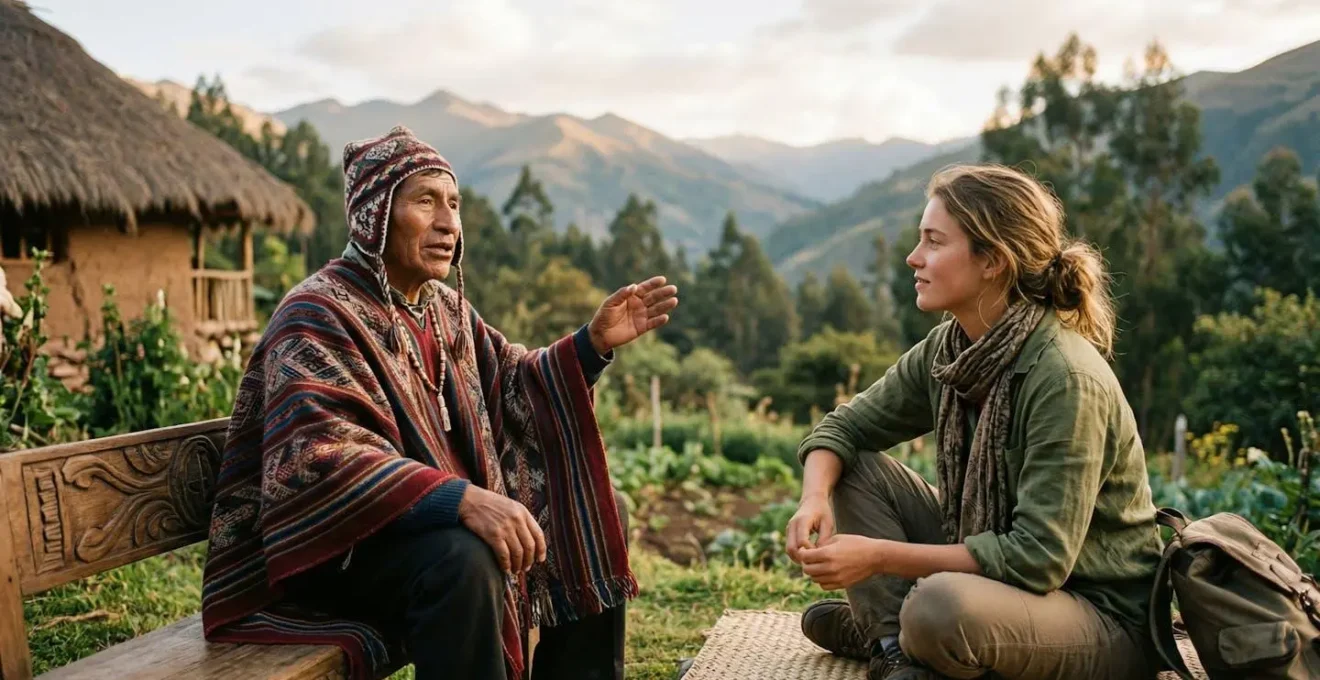
Most travelers believe respecting Indigenous culture means asking for photos and buying local, but this is a dangerously incomplete picture.
- True respect involves understanding the economic and narrative power dynamics of your visit, which often remain invisible.
- Your choices in photography, souvenirs, and tours can either inadvertently exploit or actively empower the communities you visit.
Recommendation: Shift your mindset from being a passive consumer of culture to an active ally, consciously using your travel funds and actions to support Indigenous economic agency and narrative sovereignty.
For the ethically conscious backpacker, the desire to connect with remote cultures is paired with a deep-seated fear of causing harm. We’ve all been taught the basics: dress modestly, learn a few local phrases, and always ask before taking a photograph. These are important first steps, but they are merely the visible surface of a much deeper ethical landscape. Following this simple checklist can create a false sense of security, masking the more significant, often unseen, ways that tourism can disrupt and disempower Indigenous communities.
The common advice often fails to address the fundamental structures of power and economics at play. It focuses on politeness but ignores agency. It encourages interaction but overlooks the potential for exploitation. But what if the key to truly respectful travel wasn’t just in what we do, but in understanding the *impact* of how we do it? What if the real measure of respect lies in consciously redirecting the flow of economic and narrative power back to the communities who are the stewards of their own heritage?
This guide moves beyond the superficial to explore the underlying mechanisms of ethical engagement. We will analyze the real-world consequences of our choices in photography, ritual participation, souvenir shopping, and tour selection, providing a framework for transforming your visit from a simple transaction into a meaningful and supportive partnership.
To navigate this complex terrain, this article provides a structured approach. We will delve into common mistakes and offer actionable strategies for more responsible travel, helping you become a more informed and impactful ally to the communities you have the privilege of visiting.
Summary: A Deeper Guide to Respecting Indigenous Culture on Your Journeys
- The Photography Error That Deeply Offends Local Tribal Elders
- How to Participate in Sacred Rituals Without Crossing Cultural Boundaries
- Why Purchasing Mass-Produced Souvenirs Harms Authentic Artisan Livelihoods?
- Which Respects Native Customs Better Between Guided Group Tours and Solo Visits?
- How to Directly Support Rural Craft Makers Without Using Intermediary Charities
- Why Ethical Conservation Travel Restores Degraded Habitats Faster Than Charity Donations?
- The Casual Gesture Mistake That Triggers Hostility in Southeast Asia
- How to Ensure Your Funds Support Genuine Biodiversity Conservation Destinations
The Photography Error That Deeply Offends Local Tribal Elders
The most common piece of advice for travel photographers is to “ask for permission” before taking a picture. While well-intentioned, this simple rule often fails to capture the complexity of consent. In many Indigenous contexts, a photograph is not just an image; it is a piece of data, a story, and a representation of identity. The crucial error isn’t just failing to ask, but failing to understand what true, informed consent entails. It’s about ensuring the person understands how their image will be used, where it will be seen, and for what purpose. Without this, a beautiful portrait can become an act of appropriation.
This concept is at the heart of a growing global movement. As the Crooked Compass Travel Blog notes in its guide on the topic, “The most important element of ethical cultural photography is consent. Without it, even the most beautiful image risks becoming an act of exploitation.” This elevates the conversation from simple politeness to a matter of fundamental rights. The principle of Indigenous data sovereignty asserts the rights of Native nations and Indigenous Peoples to govern the collection, ownership, and application of their own data, which includes photographic representations. When you take a photo, you are creating data. The question is: who controls it?
True consent is an ongoing dialogue, not a one-time transaction. It means explaining your intentions clearly, showing the subject the photo on your camera, and being prepared to delete it without argument. It means understanding that a person’s willingness to be in a personal holiday snapshot is vastly different from their consent to have their image posted on a public social media profile or used in a blog post. By reframing photography as a collaboration rather than an extraction, we begin to respect not just the person, but their community’s right to narrative sovereignty.
Ultimately, respecting elders and communities through photography means prioritizing their dignity and control over your desire for a “perfect shot.”
How to Participate in Sacred Rituals Without Crossing Cultural Boundaries
Witnessing a sacred ceremony is a profound privilege, and the temptation to participate—to feel a deeper connection—can be strong. However, this is where the line between respectful observer and disruptive intruder is thinnest. The critical mistake is assuming your participation is welcome or even benign. Sacred rituals are often complex, with specific roles, meanings, and protocols that are not apparent to outsiders. Your well-meaning attempt to join in can inadvertently break taboos, show disrespect, or dilute the sanctity of the event for the very people you wish to honor.
The guiding principle should always be observation over participation, unless you are explicitly and personally invited by a community leader who understands your role as an outsider. The Sacred Land Foundation advises, “Refrain from performing rituals that may be culturally unacceptable or offensive. Most sites have people who are specially trained to perform rituals.” The real-world impact of ignoring this is significant. A study on tourism at a sacred monastery highlighted the tension, noting that tour groups wandering through the premises during ceremonies created a major disturbance. This tension between tourism revenue and ritual sanctity demonstrates how the mere presence of unmanaged tourism can degrade the spiritual experience for the local community.
Maintaining a respectful physical distance is the most visible way to honor this boundary. It communicates that you are there to learn and witness, not to consume or appropriate their spiritual practice.
As the image above illustrates, true respect in this context is about making yourself small. It’s about understanding that the event is not for you; you are simply a guest. Instead of seeking a role within the ritual, focus on being a model observer: silent, unobtrusive, and deeply grateful for the privilege of being allowed to bear witness. This quiet reverence is a far more powerful sign of respect than any clumsy attempt at participation.
This approach ensures the ritual integrity of the ceremony remains intact, preserving its power and meaning for the community itself.
Why Purchasing Mass-Produced Souvenirs Harms Authentic Artisan Livelihoods?
The desire to bring home a tangible memory of a journey is universal. Yet, the seemingly innocent act of buying a souvenir can have damaging ripple effects. The proliferation of cheap, mass-produced trinkets designed to look “authentic” is a significant threat to Indigenous artisans. These factory-made imitations flood local markets, undercutting the prices of genuine, handcrafted goods and creating a race to the bottom that artisans cannot win. When a traveler chooses a $5 knock-off over a $50 handcrafted original, they are not just saving money; they are casting a vote against cultural preservation and sustainable livelihoods.
The price difference reflects a vast disparity in labor, skill, and cultural value. As one Atayal weaver from Taiwan expressed, her community’s work is devalued by this unfair competition:
The tourists say that our (indigenous) weaving products are much more expensive than the ones sold by the Han Chinese. Of course, they are cheap because they are not hand-made. Their stuff is nothing like our Atayal weaving.
– Atayal Weaver, Taiwan, The Legal Protection of Indigenous Souvenir Products
This isn’t just about economics; it’s about the survival of cultural knowledge. Research on this topic reveals that authentic hand-made goods, like molas, can take weeks to complete, justifying their higher price. The influx of cheap copies makes it impossible for artisans to receive fair compensation, forcing many to abandon the traditional skills passed down through generations. This process is a form of cultural dilution, where the meaning and value of a craft are eroded by commercialization.
To combat this, the conscious traveler must become a discerning buyer. This means seeking out cooperatives, visiting artisans in their workshops, and asking questions about the process. It requires looking beyond the price tag to see the story, skill, and heritage embedded in an authentic piece. Your purchase can be a powerful act of support, providing direct economic agency to the maker and helping to sustain their craft for the future. Every dollar spent on a genuine handicraft is an investment in cultural continuity.
Choosing authenticity over convenience is one of the most direct ways a traveler can honor and sustain the cultural heritage they have come to admire.
Which Respects Native Customs Better Between Guided Group Tours and Solo Visits?
A common debate among travelers is whether it’s more ethical to travel solo, allowing for spontaneous and “authentic” interactions, or to join a guided tour. The question, however, is framed incorrectly. The issue isn’t the size of the group; it’s about who holds the power and controls the narrative. A solo traveler, despite their best intentions, can easily blunder into cultural missteps, misinterpret situations, and inadvertently cause offense. Conversely, a mass-market tour can treat a community like a human zoo, creating a superficial and exploitative experience. The key differentiator for ethical engagement is choosing experiences that are Indigenous-led.
An Indigenous-led tour, whether for a group or an individual, ensures that the community is in control. They decide what stories to share, what sites to show, and what interactions are appropriate. The guides are not just employees; they are cultural ambassadors from the community itself, providing context and depth that an outsider never could. As Destinations International points out, “By creating authentic, Indigenous led experiences, destination organizations can not only preserve cultural heritage but also ensure that tourism growth in their communities is inclusive and respectful.” This model transforms tourism from something that *happens to* a community into a tool the community uses for its own economic and cultural goals.
The challenge for the traveler is to identify these genuinely community-centric operators from those who simply use “eco” or “cultural” as marketing buzzwords. It requires due diligence and asking the right questions before you book. This is where your power as a consumer can drive positive change.
Your Action Plan: Vetting an Ethical Tour Operator
- Direct Benefit: Ask what percentage of the tour cost is paid directly to the community hosts and members involved.
- Local Employment: Verify that the guides are members of the local Indigenous community, not outsiders.
- Long-Term Commitment: Inquire about the company’s long-term relationship and tangible commitments to the community’s well-being.
- Authentic Experience: Request information on how the tour ensures the experiences are genuinely community-led and not staged performances.
- Protocol Adherence: Check if the operator follows recognized Indigenous tourism protocols and can name their community partners.
By prioritizing Indigenous-led tours, you are not just buying a travel experience; you are investing in a model of tourism that is equitable, sustainable, and truly respectful of native customs.
How to Directly Support Rural Craft Makers Without Using Intermediary Charities
While charities can do important work, the most empowering way to support artisans is often to bypass intermediaries and put money directly into their hands through fair trade. The goal is to foster economic agency, giving makers control over their own business and destiny. This means seeking out systems where artisans are not just passive recipients of aid, but active participants and owners of their enterprise. This shifts the dynamic from one of dependency to one of partnership.
A powerful model for this is the artisan cooperative. These are organizations owned and managed by the craftspeople themselves. They pool resources, share knowledge, and collectively market their products, allowing them to command fairer prices and retain a larger share of the profits. By buying from a cooperative, you are supporting a structure that is inherently more equitable and sustainable. Research on local economies confirms that for many, traditional crafts are a vital link to cultural heritage and a primary source of income.
The success of this model is not just theoretical. It has been proven on the ground in numerous communities around the world.
Case Study: The Sna Jolobil Weaving Cooperative Success Model
The Sna Jolobil cooperative in Highland Chiapas, Mexico, provides a powerful example. By uniting, the Maya weavers transformed their economic reality. They began marketing their intricate weavings as “textile art” rather than simple souvenirs, immediately elevating their value. Critically, they took control of the entire business, from sourcing materials to sales and marketing. This eliminated their dependence on outside brokers, ensuring that the weavers—who often spend weeks on a single piece—received a fair profit for their labor. The cooperative not only secured their economic future but also sparked a revival of ancient Maya weaving techniques.
As a traveler, you can support this model by actively seeking out these cooperatives. Ask your local guide, check at community centers, or look for shops that explicitly state they are weaver- or artisan-owned. Your purchase becomes more than a transaction; it’s a direct investment in a business model that preserves culture, empowers women, and builds resilient local economies from the ground up.
When you buy directly from the makers or their own organizations, you ensure your money acts as a powerful tool for self-determination.
Key Takeaways
- True respect goes beyond politeness; it requires supporting a community’s economic and narrative agency.
- Prioritize Indigenous-led experiences where the community controls the story and reaps the financial benefits.
- Your spending is a powerful vote: choose authentic, artisan-owned crafts and tours over mass-market alternatives.
Why Ethical Conservation Travel Restores Degraded Habitats Faster Than Charity Donations?
For many Indigenous communities, their land is not just a resource; it is the foundation of their culture, spirituality, and identity. The pressure to engage in destructive industries like logging or mining often comes from a lack of viable economic alternatives. This is where ethical, Indigenous-led tourism emerges as a powerful force for conservation. Unlike a one-time charitable donation, tourism can create a sustainable, long-term economic incentive to protect natural habitats. When a community can generate more income from a living forest than a dead one, the choice becomes clear.
This model reframes the relationship between travelers and communities into a conservation partnership. The visitor’s funds provide the resources for communities to act as stewards of their ancestral lands. This is not just theory; a study from George Washington University’s International Institute of Tourism Studies found that “By providing a reliable source of income, tourism can offer Indigenous communities an incentive to maintain their cultural and natural heritage.” Critically, it also allows them to share their lands and culture on their own terms, maintaining control and agency.
This approach has proven more sustainable than resource extraction in many regions. A review of Indigenous-led tourism as a conservation incentive shows that communities are increasingly moving toward this model because it is community-centric, environmentally protective, and creates jobs at all skill levels while ensuring cultural control. By choosing to visit a community-run eco-lodge or hiring a local nature guide, you are directly funding the protection of that ecosystem. Your presence demonstrates to the community and to external bodies that their biodiversity has tangible economic value.
Your travel dollars become a direct investment not just in a vacation, but in the long-term health of a critical ecosystem and the sovereignty of its guardians.
The Casual Gesture Mistake That Triggers Hostility in Southeast Asia
While this guide focuses on the deeper, systemic aspects of ethical travel, it’s crucial not to dismiss the importance of surface-level etiquette. Seemingly “casual” gestures can carry immense weight and meaning in different cultural contexts, and a careless action can indeed trigger offense or hostility. The classic example in many parts of Southeast Asia is the taboo around the head and feet. Touching someone’s head, considered the most sacred part of the body, is a grave insult, while pointing your feet at a person or a sacred object is deeply disrespectful, as feet are considered the lowest and dirtiest part.
The mistake is not simply performing the wrong gesture; it’s the failure to do the basic research that would have prevented it. Arriving in a new country without any understanding of its core social taboos signals a profound lack of respect. It implies that you expect the host culture to adapt to you, rather than the other way around. This is why pre-trip preparation is not just a helpful tip; it’s a fundamental ethical obligation.
This preparation goes beyond memorizing a list of “don’ts.” It involves trying to understand the “why” behind the custom. The reverence for the head, for example, is often tied to spiritual beliefs about the soul. Understanding this underlying belief transforms a simple rule into a meaningful act of cultural empathy. A good local guide is invaluable here, as they can explain the nuances of what to do and, more importantly, why it matters. Observing local customs around personal space, eye contact, and even the use of silence will provide further clues to navigating social interactions gracefully and avoiding the shame associated with causing embarrassment for yourself or your hosts.
These small acts of cultural awareness demonstrate your willingness to be a respectful and humble guest, opening the door to more genuine and meaningful connections.
How to Ensure Your Funds Support Genuine Biodiversity Conservation Destinations
In an era of greenwashing, nearly every destination claims to be “eco-friendly.” For the ethical traveler, the challenge is to distinguish genuine conservation efforts from clever marketing. A truly sustainable destination is one where your funds are not only preserving biodiversity but are also empowering the local and Indigenous communities who are the primary stewards of that land. The key is to look for evidence of deep integration and shared governance, not just surface-level green initiatives.
The Indigenous Tourism Association of Canada provides a clear and powerful definition of what “genuine” looks like in this space:
Indigenous tourism is defined as a tourism business majority-owned, operated and/or controlled by First Nations, Métis or Inuit peoples which demonstrate a connection and responsibility to the local Indigenous community and traditional territory where the operation is based.
– Indigenous Tourism Association of Canada, Indigenous Cultural Tourism Protocol
This definition provides a powerful checklist. Is the business majority-owned and operated by community members? Does it demonstrate a clear responsibility to the wider community and territory? These are the questions you need to ask. A genuine conservation destination will be transparent about its operations and impact. Ask to see their sustainability reports. Inquire how local communities are involved in decision-making and what percentage of revenue stays local. Verify that they source food and labor from the surrounding area. An operator who is truly committed will be proud to share this information.
Your goal is to support a holistic system, not just a single project. The most effective conservation models are those where environmental protection and community empowerment are inextricably linked. By choosing destinations that embody this integrated approach, you ensure that your travel is a positive force on all fronts, contributing to the resilience of both the ecosystem and the culture that has protected it for centuries.
Apply this critical lens to your future travel planning, and transform every trip into a deliberate act of positive impact, ensuring your journey enriches the places you visit long after you’ve returned home.