
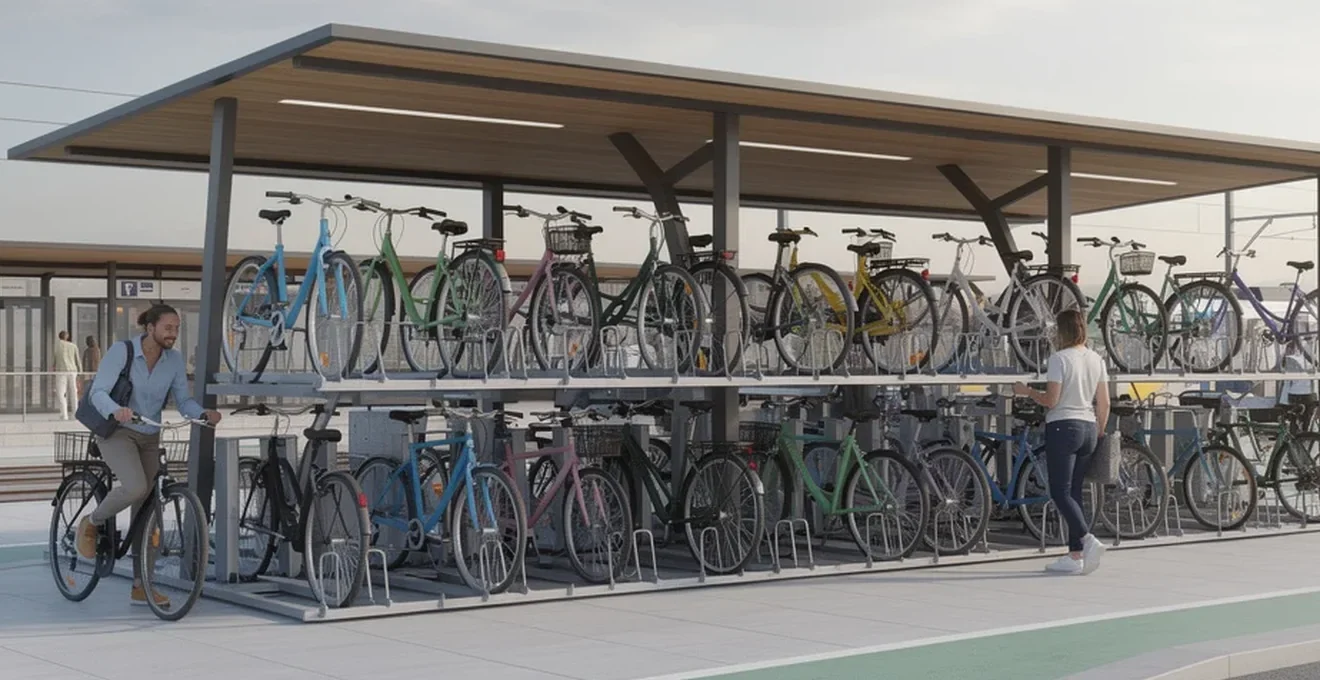
Cities across the world are investing in cycle lanes, yet a critical piece of the puzzle is often overlooked: what happens once cyclists reach their destination. Research into Switzerland’s national travel survey found that bicycle parking was available at only 76.2% of trip destinations on average, compared with 90.9% free car parking availability at the same types of destination. This gap matters because the presence, quality and security of bicycle parking directly shape whether people choose to cycle at all. This article examines why parking infrastructure is central to modal shift, the different types of parking systems available, how planning policy and behavioural psychology influence uptake, and what municipalities can do to close the parking gap between bicycles and cars.
Why cycle parking infrastructure determines modal shift success
Transport authorities have historically prioritised cycle lanes over parking, assuming cyclists can improvise a solution at their destination. The evidence suggests otherwise. When bicycle parking is scarce, cyclists resort to what researchers term « fly parking » — locking bikes to street furniture, railings or signposts — which is widely recognised as a sign of undersupply rather than a viable long-term solution. If people cannot be confident of finding secure, convenient parking at the end of a journey, many will default back to the car, where free parking remains far more consistently available.
This is why parking deserves equal weight to lanes and paths in any strategy aiming to grow cycling’s share of trips. A cyclist’s decision to travel by bike is shaped as much by what awaits them at the destination as by the safety of the route itself.
The netherlands model: utrecht fietsflat and amsterdam central station facilities
The Netherlands remains the reference point for large-scale cycle parking provision. In Amsterdam, the Central Station’s bike parking facilities were expanded in 2023 to include two new sites offering space for 11,000 bicycles. These facilities were deliberately built to connect seamlessly with both the metro station and the Central Station itself, giving cyclists a dry, direct route between modes. Elsewhere in the Netherlands, many train stations now offer indoor bike parking garages with thousands of spaces, often combined with additional services such as bike repair stations, e-bike charging points and rental or sharing schemes. These facilities have grown in popularity precisely in the cities most focused on reducing car dependency, demonstrating that ambitious parking infrastructure and modal shift go hand in hand.
Correlation between bike theft rates and parking abandonment statistics
Security concerns are a direct barrier to parking uptake. Where facilities lack surveillance or robust locking infrastructure, cyclists are more likely to avoid them altogether, choosing instead to park informally closer to their final destination or to abandon cycling for that trip in favour of another mode. This dynamic is particularly pronounced for e-bikes: Swiss survey data found that, for seven out of eight trip purposes, e-bike stages were completed with lower shares of parking at the destination than regular bicycle stages, with the difference statistically significant for four purposes. One plausible explanation is that e-bikes increasingly come with built-in frame locks, GPS tracking and alert-based theft detection which, combined with their greater weight, act as a deterrent to opportunistic daytime theft — reducing the perceived need to seek out formal parking. Given that e-bikes are considered central to a sustainable mobility system, this pattern is a cause for concern rather than reassurance, since it may reflect owners relying on the bike’s own security features rather than genuinely adequate infrastructure.
First-mile and Last-Mile barriers in multimodal journey planning
Many cycling trips are not stand-alone journeys but connectors to public transport. Bike-sharing programmes are one clear response to this « last mile » challenge, offering a flexible alternative to private car use for the final stretch of a journey. Docking stations located near metro and bus stations allow commuters to pick up a bike for the last leg of their trip, or to use it for shorter journeys around the city, without needing to worry about where their own bicycle is parked. Systems built around this principle have shown that integrating shared bikes into the wider transit network measurably extends the practical reach of public transport.
Typologies of bicycle parking systems and their technical specifications
Not all cycle parking is created equal, and the design of racks, shelters and storage systems has a direct bearing on whether cyclists actually use them.
Sheffield stands versus Wheel-Bender racks: design flaws and fixes
Simple, well-designed stands allow a cyclist to secure both wheels and the frame, offering stability and resistance to tampering. Poorly designed alternatives, by contrast, support only the front wheel, leaving the frame unsecured and the bike prone to damage or theft. Street furniture manufacturers now offer a spectrum of solutions, from simple hoops and parking racks to fully customised systems, designed to be durable, blend into the surrounding environment and remain functional over the long term.
Automated bike vaults and robotic parking towers (japan’s eco cycle model)
In Tokyo, many train stations have adopted fully automated underground bike parking systems that combine high capacity with enhanced security. These vaults remove bicycles from view and street-level exposure entirely, giving commuters confidence that their bike will remain secure and undamaged throughout the working day. This type of infrastructure demonstrably encourages more people to cycle to the station, precisely because the uncertainty around parking security has been engineered out of the journey.
Covered cycle hangars and On-Street residential parking pods
Weather exposure is a frequently underestimated deterrent. Cyclists are less inclined to use a facility if they know their bike will be left exposed to rain, snow or UV damage while parked. Covered or sheltered parking — including hangars with canopies over bike-and-ride facilities — keeps bicycles dry and undamaged, and materially improves the overall user experience at transit hubs and residential locations alike, encouraging use regardless of weather conditions.
Secure cycle parking (sold secure and ART certification standards)
Durability and build quality also contribute to perceived and actual security. Using high-quality, tamper-resistant materials such as stainless steel or aluminium for racks and stands extends the lifespan of facilities while making them significantly harder to damage or circumvent. Combined with CCTV surveillance and access-controlled areas restricted to authorised users, robust physical security materially reduces theft and vandalism, since those intent on stealing bikes are less likely to target locations where they know they will be recorded or challenged.
Integrating bicycle parking within Transport-Oriented development
Parking infrastructure delivers the greatest benefit when it is planned as part of a wider, connected mobility network rather than as an isolated amenity.
Bike-and-ride hubs at rail interchanges: copenhagen’s nørreport station case study
Dedicated bike-and-ride facilities at rail interchanges allow commuters to park safely and continue their journey by public transport, and the most effective examples include more than bare racks. Indoor bike parking garages paired with repair stations, e-bike charging points and rental or sharing options give commuters confidence that switching between cycling and transit will be straightforward at every stage of the journey, not just at the point of arrival.
Parking provision standards in local planning policy (sustrans guidance and TfL cycling design standards)
Location is one of the most decisive factors in whether cycle parking gets used. Facilities should be positioned as close as possible to transit hubs, workplaces, shopping centres, universities and other points of interest, since this proximity is what makes cycling viable as part of an intermodal journey. Clear signage directing cyclists to available parking further improves accessibility and ensures that provision is actually found and used rather than overlooked.
Capacity planning matters just as much as location. Authorities need to assess existing demand, anticipate growth as cycling becomes more popular, and ensure enough space is available to avoid overcrowding — while also designing modular or expandable facilities so that capacity can increase as demand rises, particularly around peak commuting hours.
End-of-trip facilities: showers, lockers and workplace cycle parking under BREEAM credits
Workplace destinations already provide comparatively strong bicycle parking opportunities, with Swiss survey data showing 88.8% availability at work-related stage destinations — among the highest of any trip purpose measured. Complementary facilities extend this further: storage spaces for helmets, backpacks and locks give cyclists confidence that their belongings will be safe while they are away from their bike, and repair stations equipped with basic tools allow users to resolve common issues such as flat tyres, brake adjustments or gear problems without their commute grinding to a halt. Electric bike charging points are an increasingly essential addition, ensuring e-bike commuters are not left worrying about range for the return journey.
Behavioural economics behind cycle parking uptake
The decision to use — or avoid — a piece of cycle parking infrastructure is rarely purely rational. Perception, visibility and ease of decision-making all play a role.
Perceived security and the broken windows theory applied to bike racks
Lighting is a critical, often underestimated element of cycle parking security. Well-lit facilities improve visibility at night and act as a deterrent to criminal activity, since those looking to steal or vandalise bikes generally prefer dark, poorly overlooked locations. The presence of surveillance cameras reinforces this effect further: cameras not only allow real-time monitoring of suspicious activity but their mere visibility can significantly reduce theft and vandalism, as potential offenders are less likely to target places where they know they may be recorded. A neglected, poorly lit or visibly under-used rack area can therefore create a self-reinforcing cycle of avoidance, in much the same way that visible signs of disorder are understood to invite further disorder.
Wayfinding signage and its influence on parking utilisation rates
Even the best-designed parking facility is of limited value if cyclists cannot find it. Clear, well-placed signage directing cyclists towards designated parking areas removes friction from the decision to park correctly rather than resorting to informal solutions such as locking to street furniture. This is particularly important at large or multi-entrance transit hubs, where the shortest route to a platform is not always the route past the designated parking area.
Municipal policy levers for scaling bicycle parking networks
Delivering parking infrastructure at the scale required for genuine modal shift depends on planning frameworks, funding mechanisms and legal instruments that make provision a default requirement rather than an afterthought.
Section 106 contributions and developer obligations for cycle infrastructure
Planning obligations attached to new developments offer one route through which local authorities can secure cycle parking provision as new buildings and transport interchanges are built, ensuring infrastructure keeps pace with growth rather than being retrofitted after demand has already outstripped supply.
London cycling design standards (LCDS) parking density requirements
Legislative change has also reshaped how kerbside space is allocated. Since the introduction of law no. 2019-1428 on the orientation of mobility in France, for example, it has been necessary to remove obstacles and prohibit motorised parking within five metres of pedestrian crossings, in order to protect visibility at intersections and improve pedestrian safety. Critically, these reclaimed spaces may then be reserved for cycles and personal transport devices, turning a road-safety requirement into an opportunity to expand cycle parking density in exactly the locations where demand is highest.
Public-private partnerships: cyclehoop and local authority procurement models
Local authorities do not need to deliver every element of cycle parking infrastructure alone. Photovoltaic technology, for instance, can now power equipment such as charging stations for electric bikes and scooters, lockers, and bicycle shelters that include video surveillance and lighting along cycle lanes. Solutions of this kind — combining renewable energy generation with storage — can make bicycle shelters self-sufficient, occupy minimal pavement space, and deliver safer parking without placing additional demand on the municipal electricity grid. These kinds of technical partnerships between local authorities and specialist providers allow councils to deliver more ambitious, secure and sustainable parking networks than public budgets alone might otherwise support.
Measuring the modal shift impact of enhanced bicycle parking
Ultimately, the value of parking investment must be judged against its effect on cycling uptake and the wider sustainability of the transport network.
Before-and-after case studies: seville’s cycle parking expansion programme
Assessing whether parking provision has genuinely kept pace with demand requires the kind of population-level data that remains surprisingly scarce. A useful benchmark — a « sustainable mobility test » — is to compare the availability of free car parking against bicycle parking at equivalent destination types. Applied at a national level in Switzerland, this test found that bicycle parking was significantly less available than free car parking for the great majority of trip purposes, with education settings and transfers at transit stations being the notable exceptions. This kind of before-and-after, mode-against-mode comparison offers a replicable framework that other cities and regions could apply to their own infrastructure investment programmes to judge genuine progress rather than relying on anecdotal impressions.
Key performance indicators for active travel strategies
Robust measurement depends on collecting the right data in the first place, and current practice has notable gaps. Bicycle parking research has historically concentrated on worksite parking, transit station parking, and the general relationship between parking availability and cycling levels, while most large-scale travel surveys do not collect bicycle parking data at all, and virtually no studies specifically examine e-bike parking. Useful indicators for active travel strategies going forward include: the share of trips by purpose that end with parking availability at the destination; comparative availability of free car parking versus bicycle parking for equivalent trip types; and the proportion of e-bike versus regular bicycle trips served by secure destination parking. Improving clarity on the proximity, quality and abundance of parking — and standardising how survey questions capture this information — will be essential to tracking whether infrastructure investment is genuinely closing the gap between cycling and car use.