
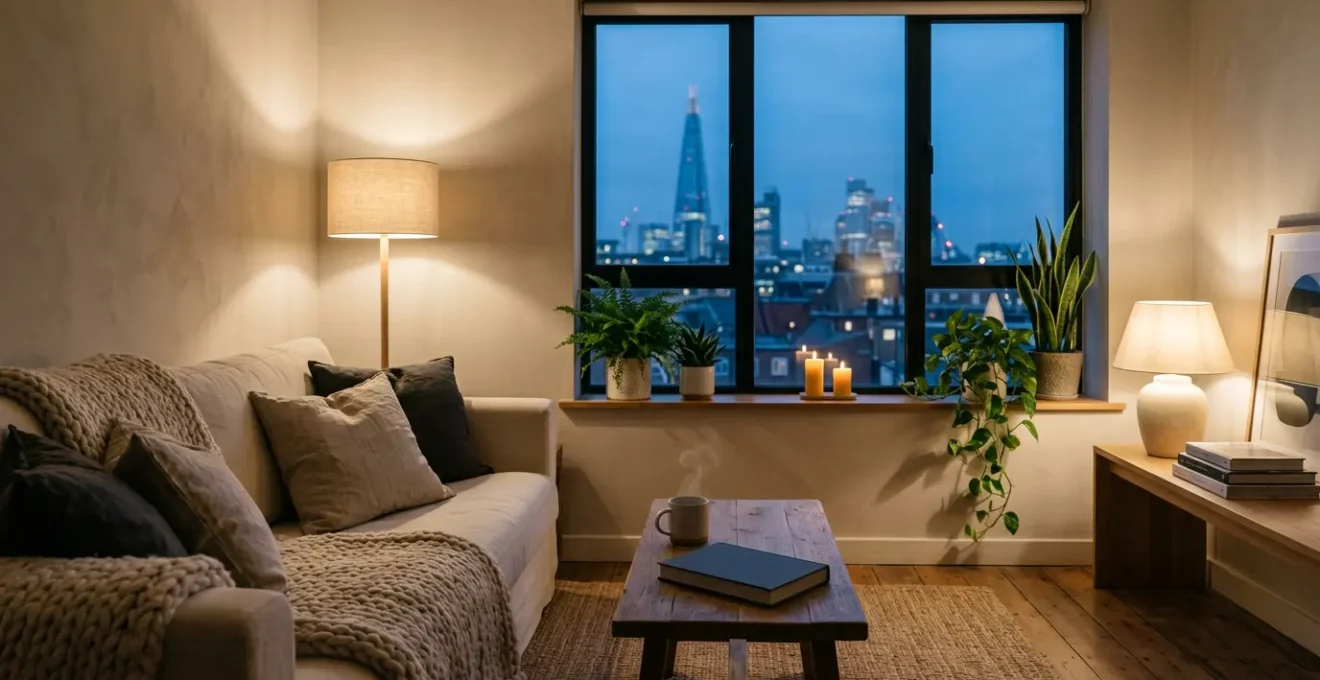
Contrary to popular belief, true Hygge isn’t about scattering candles and throws; it’s a deliberate neuro-sensory reset designed to dismantle commute-induced stress from your nervous system.
- Overhead cool-toned LED lighting actively suppresses melatonin, the hormone your brain needs to switch off.
- Synthetic fragrances found in many home products can trigger headaches and anxiety, sabotaging your attempt to relax.
Recommendation: Create a ‘sensory airlock’ ritual for the first five minutes you’re home to signal a definitive end to the day’s sensory assault and begin genuine decompression.
The moment the front door clicks shut behind you, the noise of the London Underground still ringing in your ears, a familiar tension settles in your shoulders. For many London commuters, home is supposed to be a sanctuary, yet the digital pings and harsh glare of modern living often just continue the day’s sensory assault. The common advice is to embrace « Hygge »—the Danish art of coziness. This usually translates into buying a few woolly blankets and lighting some vanilla-scented candles, hoping for the best.
But what if this aesthetic-first approach is fundamentally flawed? What if those very candles are triggering headaches, and the overhead lighting is secretly telling your brain to stay on high alert? As a Danish lifestyle consultant, I see many stressed Brits attempt to decorate their way to tranquility. They focus on how a room looks, not on how it makes their nervous system *feel*. The result is a space that looks cozy on Instagram but offers no real psychological refuge from the relentless pace of city life.
The true key to decompressing is not about adding more ‘cozy’ items. It’s about systematically *removing* the hidden stressors in your environment and replacing them with intentional, neurologically calming signals. This guide is not about aesthetics; it’s a practical, science-backed framework for turning your living room into a genuine sensory deprivation sanctuary. We will move beyond clichés to build an environment that actively helps your brain and body unwind, starting with the foundational elements of light, touch, and scent.
This article provides a structured approach to transforming your home into a true sanctuary. Below, you will find a summary of the key areas we will explore to help you systematically decompress after a long day.
Summary: A Neuro-Sensory Guide to Post-Commute Hygge
- Why Overhead LED Lighting Destroys Your Brain’s Ability to Produce Melatonin?
- How to Map Multiple Low-Level Light Sources for Ultimate Evening Relaxation
- Which Adds Authentic Tactile Comfort Better Between Wool Throws and Faux Fur?
- The Synthetic Scent Trap That Triggers Headaches Instead of Calm
- When to Transition Your Home Environment From Active Day to Restful Evening
- Why Ignoring Physical Tension Propagates Chronic Digital Anxiety Loops?
- Which Unwinds a Stressed Brain Better Between Narrative Walking Simulators and Grand Strategy Games?
- How to Elevate Your Digital Entertainment Diet to Cure Chronic Evening Doomscrolling
Why Overhead LED Lighting Destroys Your Brain’s Ability to Produce Melatonin?
When you walk in after a long commute and flick on the main ceiling light, you are unknowingly sending a powerful signal to your brain: « It’s the middle of the day. Stay alert. » Most modern homes are fitted with cool-toned overhead LED lights, which are rich in the blue light spectrum. This light is a direct antagonist to your body’s natural winding-down process because it severely inhibits the production of melatonin, the essential hormone that signals it’s time for rest.
The science is clear and damning for the common « big light ». A study published in Scientific Reports found that cool white LED lamps (12.3% melatonin suppression) are significantly more disruptive than warm white LEDs (3.6%) or traditional incandescent lamps (1.5%). This means your standard kitchen or living room spotlight is actively fighting against your desire to relax, keeping your nervous system in an artificially stimulated state. This single environmental factor can be the root cause of difficulty falling asleep and a feeling of being « wired and tired » in the evening.
To cultivate neurological calm, the first and most critical step is to kill the overhead light. The goal is to mimic the natural progression of sunset, which means shifting your home’s light profile from bright and blue-toned to warm and low. This isn’t just an aesthetic choice; it’s a biological imperative for anyone seeking to decompress. The visual representation below shows the kind of warm, gentle glow you should aim for.

As this image demonstrates, the focus is on creating pools of soft, golden light rather than uniform, harsh brightness. Research from Harvard has even shown that participants exposed to warm light in the evening not only produced more melatonin but also fell asleep 19 minutes faster than those exposed to cool light. By consciously managing your evening light, you are taking direct control over your brain’s sleep-wake cycle.
How to Map Multiple Low-Level Light Sources for Ultimate Evening Relaxation
Once you’ve made the commitment to abandon the « big light, » the next step is to build a replacement system. The goal is to create a « light-scape » using multiple, low-level sources to produce a gentle, ambient glow. Think of yourself as a lighting designer for your own nervous system. Instead of one harsh source from above, you will orchestrate several soft sources from below eye-level, which is inherently more calming and mimics the light of a campfire or hearth.
Your strategy should be based on « zoning. » Identify the key areas of your room for evening activity: the entryway, the sofa or reading chair, and perhaps a dining area. Each zone should have its own dedicated, warm light source—a table lamp, a floor lamp, or even a low-wattage accent light. The key is to use bulbs with a warm color temperature, ideally 2700K or lower. Many smart bulbs now offer « dim-to-warm » technology that automatically reddens the light as you lower the brightness, perfectly emulating a setting sun.
Create a gradient of light that supports your transition from the outside world. The light in your entryway might be slightly brighter, dimming as you move towards your « sofa sanctuary. » This creates a psychological pathway, guiding you from the sensory chaos of the commute into a cocoon of calm. Automating this process with smart plugs or bulbs can be transformative. Imagine a pre-set « Post-Commute » scene that you can activate with a voice command or a single button press, instantly changing your home’s entire atmosphere from a functional daytime space to a restful evening haven.
Action Plan: Zoning Your Light for Decompression
- Entryway Transition Zone: Position a small lamp on a console table near the door. Set it to a low brightness to act as a welcoming beacon without being jarring.
- Sofa Sanctuary: Place a floor lamp behind your sofa and a smaller table lamp on a side table. This creates layered, indirect light that’s perfect for reading or relaxing without screen time.
- Task-Specific Lighting: If you read, use a dedicated, low-intensity reading light. This avoids the need to illuminate the whole room for a single activity.
- Pathway Lighting: Use very low-wattage accent lights or even smart LED strips under furniture to create safe, non-disruptive pathways to the kitchen or bathroom at night.
- Smart Automation: Program a « Wind-Down » scene that gradually dims all lights over 30 minutes before your intended bedtime, providing a clear, gentle cue to your body that sleep is approaching.
This deliberate mapping of light is far more effective than the random placement of a few lamps. It’s an active system designed to guide your brain chemistry toward a state of rest and recovery.
Which Adds Authentic Tactile Comfort Better Between Wool Throws and Faux Fur?
When creating a Hygge environment, the conversation around textiles often defaults to a simple visual preference: do you prefer the rustic, natural look of wool or the plush, luxurious feel of faux fur? While both can contribute to a cozy aesthetic, the choice becomes more meaningful when viewed through the lens of tactile comfort and its effect on a stressed nervous system. The question isn’t just « which looks cozier? » but « which *feels* more grounding? »
Wool, particularly heavy-knit varieties like merino or chunky cable-knit, offers a satisfying weight and a natural, breathable texture. Its heaviness provides a subtle, calming pressure that can be deeply reassuring after a day spent in the light, ungrounded environment of public transport. The natural fibers also regulate temperature well, providing warmth without causing overheating—a common issue with synthetic materials that can lead to discomfort and restlessness.
Faux fur, on the other hand, excels at providing a different kind of sensory input: softness and smoothness. The fine, silky fibers can be incredibly soothing to the touch, triggering a positive sensory response that can reduce anxiety. For someone who is « touched out » by the jostling of a crowded commute, the gentle stroke of a high-quality faux fur can act as a psychological reset. However, lower-quality versions can feel synthetic and plasticky, and they lack the grounding weight of natural wool.
Ultimately, the most effective approach may not be a choice between the two but an understanding of a deeper principle: Deep Pressure Stimulation. This is where the concept of a weighted blanket becomes highly relevant, elevating the discussion beyond simple texture.
Case Study: The Calming Power of Deep Pressure Stimulation
The debate between wool and faux fur focuses on surface texture, but the science of tactile comfort points to the importance of weight. A 2020 systematic review in the American Journal of Occupational Therapy found that weighted blankets significantly reduce anxiety. In the studies analyzed, 63% of participants reported lower anxiety, and 78% stated they preferred using the weighted blanket as a tool for calming down. The effect comes from Deep Pressure Stimulation, which activates the parasympathetic nervous system (the « rest and digest » system). This releases feel-good neurochemicals like dopamine and serotonin, helping to lower heart rate and relax muscles. This suggests that the *weight* of a throw, whether wool or a dedicated weighted blanket, may be more crucial for post-commute decompression than its surface texture alone.
The Synthetic Scent Trap That Triggers Headaches Instead of Calm
In the quest for a cozy atmosphere, scent is a powerful tool. The market is flooded with plug-in air fresheners, scented candles, and room sprays promising to fill your home with calming aromas like « Ocean Breeze » or « Vanilla Cookie. » However, for many, these products do the exact opposite, creating a « synthetic scent trap » that can trigger headaches, nausea, and a general sense of unease, effectively sabotaging any attempt at relaxation.
The problem lies in the chemical composition of these fragrances. Most are made from a complex cocktail of synthetic volatile organic compounds (VOCs), which are released into the air you breathe. These chemicals are a known trigger for a significant portion of the population. In fact, research reveals that migraine episodes associated with fragranced product exposure occurred in 12.6% of the general population. For those already prone to migraines, the link is even stronger, with over 90% reporting odors as a trigger. Coming home after a stressful commute only to be assaulted by a powerful, artificial scent can be the final straw for an overstimulated nervous system.
The biological mechanism behind this is direct and intrusive. As fragrance sensitivity research points out, these synthetic compounds can have a direct neurological impact. An expert from the Tangie Co fragrance safety study explains:
Synthetic volatile organic compounds (VOCs) in plug-ins can irritate the trigeminal nerve, directly causing headaches and unease.
– Fragrance sensitivity research, Tangie Co fragrance safety study
To truly use scent for decompression, you must abandon synthetic fragrances and turn to natural, plant-derived alternatives. This means using an ultrasonic diffuser with high-quality, pure essential oils like lavender, bergamot, or cedarwood. These not only provide a gentle, non-overpowering aroma but also contain natural compounds that have been shown to have genuine calming properties, working with your body’s chemistry instead of against it.

The shift is from perfuming a room to creating a therapeutic atmosphere. A natural diffuser releases a subtle, breathable mist that cleanses the air and provides a gentle sensory cue for relaxation, as visualized by the pure, organic elements in the image above. It’s the difference between a loud, chemical shout and a soothing, natural whisper.
When to Transition Your Home Environment From Active Day to Restful Evening
The transition from the chaos of a London commute to the calm of your home sanctuary should be a distinct and deliberate event, not a gradual, messy bleed-over. The moment you step through the door is the most critical. If you walk in, drop your bags, and immediately start checking emails on your phone under a harsh kitchen light, you’ve carried the stress of the day with you. The « active day » mindset has breached the walls of your refuge.
The solution is to create what can be called a « Sensory Airlock »—a non-negotiable ritual that takes place in the first five minutes of arriving home. This ritual acts as a hard border between your public, commuter self and your private, restful self. Its purpose is to systematically shed the physical and psychological residue of the city before you proceed further into your home. This isn’t about adding another task to your day; it’s about creating an automatic sequence that trains your brain to switch gears upon arrival.
This ritual is built on a series of simple, sensory-based actions. It starts with the physical act of removing your shoes and outdoor clothing, which are symbolically and literally covered in the grime of the city. This is followed by a cleansing act, like washing your hands and face with cool water, to provide a clean sensory slate. Only then do you activate your pre-set « evening scene »—the warm, low-level lighting and gentle, natural scent we’ve discussed. Each step is a signal to your nervous system that the demand and alertness of the day are over. The sequence is repeatable and predictable, which in itself is deeply calming for a brain tired of making decisions.
The power of this ritual lies in its consistency. Over time, your brain will build a strong association between this sequence and the feeling of relaxation. The click of the lamp, the first hint of lavender from the diffuser, and the feeling of soft clothes on your skin will become powerful triggers for immediate decompression. Below is a checklist to audit and build your own five-minute sanctuary airlock.
Your Sensory Airlock Audit: The First Five Minutes Home
- Designated Drop Zone: Have you established a single, specific place by the door for your keys, bag, and coat? This prevents commute clutter from infiltrating your living space.
- Immediate Wardrobe Change: Are comfortable « home clothes » easily accessible? The act of changing is a powerful psychological trigger for transitioning from a « public » to a « private » self.
- Physical Cleansing Station: Is your bathroom or a small sink area prepared for a quick hand and face wash? This symbolic act « washes away » the commute.
- One-Touch Scene Activation: Can you activate your evening lighting and scent scene with a single button, voice command, or switch? The transition should be effortless and immediate.
- Repeatable Sensory Cue: Have you chosen a consistent, unique cue to mark the end of the ritual? This could be a specific instrumental song, a deep breath, or the act of making a warm, caffeine-free drink.
Why Ignoring Physical Tension Propagates Chronic Digital Anxiety Loops?
The stress of a commute isn’t just a mental state; it’s a physical one. Your body stores the tension of the day in its muscles, posture, and even your jaw. The defensive, braced posture required to navigate a crowded train, the tight grip on your phone while doomscrolling, and the unconscious clenching of your jaw in response to noise and stress all accumulate as stored physical tension. When you get home and slump onto the sofa, this tension doesn’t just disappear. It lingers, creating a low-level state of physical alarm.
This unaddressed physical tension creates a vicious feedback loop with digital anxiety. When your body is tense, your nervous system remains in a state of hyper-vigilance. In this state, your brain is more susceptible to the anxiety-inducing nature of social media feeds, news alerts, and stressful work emails. You scroll through your phone to « relax, » but your physically tense body interprets the digital stimuli as further threats, increasing your anxiety, which in turn causes you to tense up even more. You are mentally trying to unwind while your body is still braced for impact.
Breaking this cycle requires a conscious effort to release the day’s stored tension *before* you engage in passive entertainment. This doesn’t require a full yoga session. It can be achieved through a series of « micro-releases »—small, targeted movements designed to undo the specific physical patterns of commuting. These actions send a clear signal to your nervous system that the threat is over and it’s safe to stand down. By focusing on your body first, you create a physiological foundation for genuine mental relaxation.
The practice of an evening « body scan » can be incredibly effective. Take two minutes to lie or sit quietly and mentally scan your body from head to toe, simply noticing where you feel tightness without judgment. Is it in your shoulders, your lower back, your hands? Often, the simple act of bringing interoceptive awareness—the sense of your body’s internal state—to these areas is enough to begin the process of release. This physical check-in is the antidote to the disembodied state of chronic digital anxiety.
- Jaw Release: The commuter’s jaw is often unconsciously clenched. Deliberately open your mouth wide for a few seconds and then gently let it close to release the masseter muscles.
- Neck and Shoulder Rolls: Gently roll your head from side to side and shrug your shoulders up to your ears, then let them drop completely. This counters the tension from looking around a crowded carriage.
- Wrist and Finger Stretches: Undo the « phone grip » by spreading your fingers wide and then gently bending your wrists back and forth.
- Spinal Twist: While sitting, gently twist your torso to one side, then the other, to decompress the spine from hours of cramped seating.
Which Unwinds a Stressed Brain Better Between Narrative Walking Simulators and Grand Strategy Games?
After physically decompressing, many of us turn to video games to mentally unwind. However, not all games are created equal when it comes to stress relief. The choice of digital entertainment can either continue the day’s cognitive load or provide a gentle, restorative experience. A common mistake is choosing a game that, while engaging, demands the same type of high-level strategic thinking and decision-making that your brain has been engaged in all day.
Consider the difference between two popular genres: grand strategy games and narrative walking simulators. Grand strategy games, like *Civilization* or *Stellaris*, require intense focus, long-term planning, resource management, and constant decision-making under pressure. They are, in essence, a complex second job. For a brain already fried from a day of problem-solving, diving into such a game is like running a mental marathon after a physical one. It maintains a high cognitive load and can easily perpetuate feelings of stress and alertness.
On the other end of the spectrum are narrative walking simulators. Games like *Firewatch*, *What Remains of Edith Finch*, or *Journey* are designed around exploration, atmosphere, and story, with minimal mechanical challenge. They demand very little from the player in terms of complex problem-solving. Instead, they offer a rich, immersive sensory experience—beautiful visuals, evocative sound design, and a compelling, slowly unfolding narrative. They guide the player through a world rather than demanding they conquer it.
For a stressed commuter, the walking simulator acts as a form of guided mindfulness. It engages the senses and the imagination without demanding high-stakes performance. The low cognitive load allows the brain’s executive functions to finally stand down, fostering a state of relaxed immersion that is far more conducive to unwinding. The goal of evening entertainment should be to switch from active problem-solving to passive, restorative absorption. Choosing a walking simulator over a strategy game is a conscious act of digital nutrition—feeding your brain the calm it needs, not the stimulation it’s used to.
Key Takeaways
- Your home’s overhead lighting is likely the biggest obstacle to relaxation, as cool-toned LEDs suppress the production of the sleep hormone melatonin.
- Creating a « Sensory Airlock » ritual for the first five minutes you are home is crucial to signal a clear transition from a stressful commute to a restful state.
- The most effective digital entertainment for unwinding has a low cognitive load, such as narrative-driven games, rather than complex strategy games that mimic work-related stress.
How to Elevate Your Digital Entertainment Diet to Cure Chronic Evening Doomscrolling
In the quiet of the evening, the blue glow of a smartphone is the modern-day hearth many of us gather around. Yet, instead of warmth, it often provides a stream of anxiety-inducing headlines, performative social media, and endless choices that lead to decision fatigue. This is « doomscrolling »—a mindless, compulsive consumption of digital content that leaves you feeling more drained than relaxed. Curing this habit isn’t about total digital abstinence, but about curating your digital diet with the same intention you’d apply to your food.
The first step is to classify your evening media. Think of it in three categories: « Empty Calories » (mindless scrolling on social media, newsfeeds), « Comfort Food » (rewatching a familiar, comforting TV series), and « Nutrient-Dense Media » (engaging documentaries, thought-provoking podcasts, or the story-rich games we just discussed). The goal is not to eliminate Comfort Food but to drastically reduce Empty Calories and intentionally schedule Nutrient-Dense Media. This replaces a reactive, mindless choice with a proactive, intentional one.
To do this effectively, create a pre-curated wind-down playlist for your evening. Instead of opening a social media app and seeing where the algorithm takes you, have a plan. For example: one 20-minute episode of a documentary series, followed by one episode of your favorite sitcom, and ending with 15 minutes of a cozy, low-stakes video game. This structure removes the « what should I watch? » paralysis and prevents you from falling down a rabbit hole of short, unsatisfying content. Furthermore, practice immersive monotasking: when you are watching your show, put your phone away. Give the content your full attention. The constant context-switching between a TV screen and a phone screen is incredibly taxing on the brain.
Finally, establish a firm digital cut-off time. Designate the last 30-60 minutes of your evening as a screen-free period. Use this time for truly analog relaxation: reading a physical book, gentle stretching, listening to an instrumental music playlist, or simply talking with a partner. This creates a final, crucial buffer that allows your brain to fully disconnect from the stimulating world of screens and prepare for deep, restorative sleep. By treating your media consumption as a « digital diet, » you transform your evenings from a source of passive anxiety into a period of active, intentional restoration.
Building a Hygge-inspired sanctuary is not a one-time decorating project but an ongoing practice of intentional living. It’s about understanding the subtle environmental and behavioural cues that influence your nervous system and actively shaping them to support your well-being. By starting with the foundational elements of light, scent, and texture, and extending that mindfulness to your physical and digital habits, you create a powerful system for decompression. This is the true spirit of Hygge: not just coziness, but a profound and gentle reclamation of your peace in a chaotic world. To begin this journey, the most impactful first step is to critically assess and redesign your home’s lighting.