
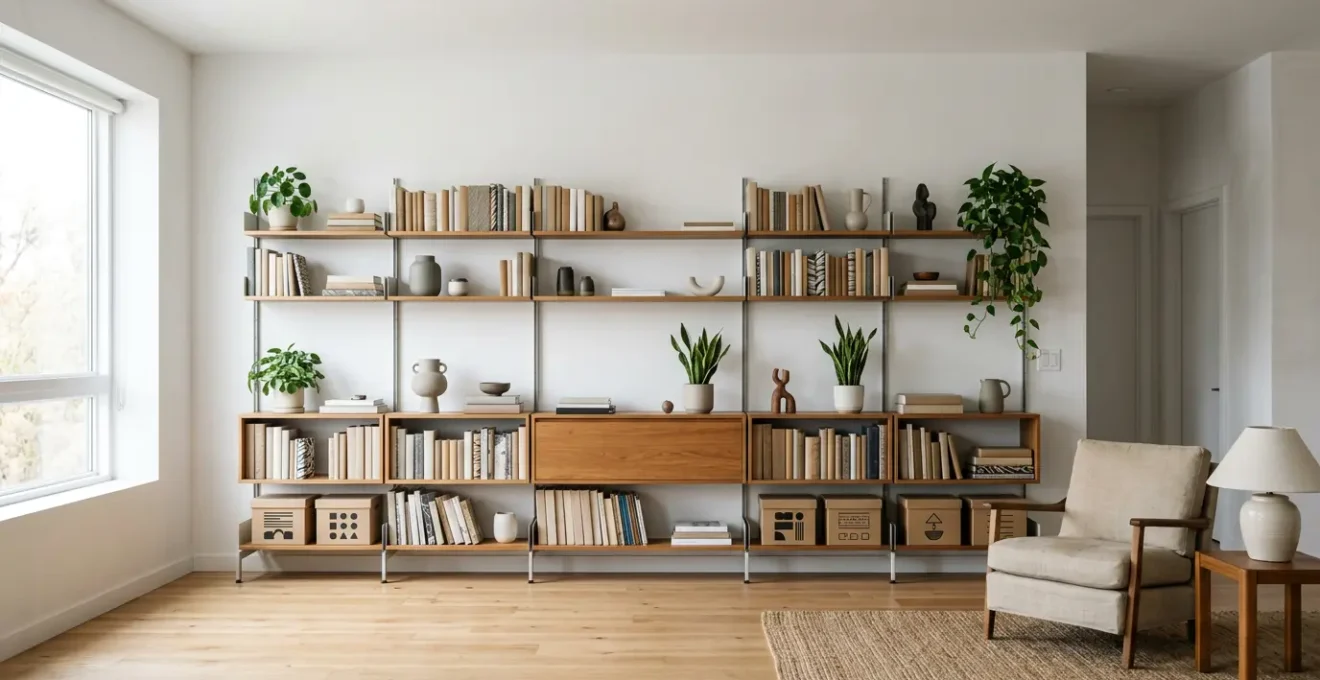
The biggest hidden expense of renting isn’t the deposit; it’s the recurring cost of disposable furniture that never quite fits your current or future home.
- Adaptable modular systems act as a portable financial asset, moving with you and eliminating the « sunk cost » of fixed installations or ill-fitting pieces.
- They are engineered to solve the unique spatial challenges of rental properties, from awkward period-property alcoves to strict no-drill wall policies.
Recommendation: Start treating your storage as a long-term personal infrastructure investment, not a temporary fix for a single space.
There’s a frustration unique to the modern renter, especially in the UK’s character-filled but often spatially challenging housing stock. You move into a new flat—a Victorian terrace in Bristol, a warehouse conversion in Manchester—only to find that your perfectly good wardrobe won’t fit the alcove, or the bookcase that anchored your last living room now creates an awkward, unusable corridor. This wasted potential is a kind of « dead zone tax » on your living space, a penalty for owning rigid, single-purpose furniture in a transient world.
The standard advice often misses the point. « Buy smaller furniture » leads to compromised storage. « Just get cheap flat-pack » condemns you to a cycle of buying, breaking, and binning with every move. And the dream of beautiful, custom built-ins? That’s an investment you make in your landlord’s property, not your own life. These solutions fail to address the core issue: the mismatch between static furniture and a dynamic lifestyle.
But what if we’ve been looking at the problem backwards? As a designer of flexible furniture systems, I see storage not as a disposable expense, but as a core piece of personal infrastructure. The goal isn’t just to furnish this current flat, but to invest in a system that adapts to every future home, layout, and life change. It’s about achieving « investment migration »—taking your valuable assets with you, rather than leaving them behind.
This guide will walk you through the design principles of future-proofing your rental life. We’ll explore how to think like a designer, transforming your storage from a series of compromises into a coherent, adaptable, and ultimately more valuable spatial asset.
Summary: A Designer’s Guide to Adaptable Modular Storage
- Which Is the Ultimate Rental Investment Between Built-In Wardrobes and Freestanding Modular Grids?
- How to Configure a Wall-to-Wall Storage Unit That Doesn’t Damage Plasterwork
- Why Standard Rigid Furniture Creates Awkward Dead Zones in Period Properties?
- The Cheap Flat-Pack Trap That Warps Under the Weight of Heavy Books
- How to Conceal Unsightly Routers and Cables Within Open Shelving Systems
- Which Opens Up Narrow Hallways Better Between Floating Shelves and Traditional Bookcases?
- Which Hides Better in a Mid-Century Lounge Between Ergonomic Stools and Posture Cushions?
- How to Integrate Workspace Ergonomics Seamlessly Into High-End Living Room Designs
Which Is the Ultimate Rental Investment Between Built-In Wardrobes and Freestanding Modular Grids?
For a renter, the concept of « investment » in furniture is fundamentally different from that of a homeowner. A homeowner sees a built-in wardrobe as an upgrade to the property. While industry estimates suggest that custom closets can recoup over 53% of their cost at resale, for a renter, this is a 100% sunk cost—a gift to the landlord. The true rental investment is not in something fixed, but in a high-quality spatial asset that can move with you.
Consider the logic of « investment migration. » A modular grid system is a personal asset. You purchase it once and it adapts to a new bedroom, a home office, or even a garage in your next five homes. A A$12,000 built-in wardrobe in one rental is abandoned, while a A$3,000 high-quality modular system is disassembled and reconfigured in the new space, preserving its full value to you. This adaptability is its core financial advantage; it can be adjusted in minutes to accommodate new needs without calling a carpenter.
This philosophy prioritises personal utility over property enhancement. As the experts at Contempo Space note, the primary concern for renters is portability. A built-in is static; it belongs to the building. A modular grid belongs to you.
For renters, portability is often the top concern when choosing furniture. Free-standing wardrobes are usually preferable because they can be taken to a new place. A fitted or fixed wardrobe wouldn’t make sense in a rental you might leave behind.
– Contempo Space, Custom Versus Ready-Made Wardrobes Guide
Choosing a freestanding modular system is a strategic decision to invest in your own adaptable future, rather than in your landlord’s fixed present. It’s the difference between buying an asset and paying for a temporary, immovable feature.
How to Configure a Wall-to-Wall Storage Unit That Doesn’t Damage Plasterwork
One of the great appeals of high-end interior design is the seamless, « built-in » look. Yet for a renter, achieving this aesthetic is a paradox: how do you create a floor-to-ceiling, wall-to-wall unit without drilling a single hole and forfeiting your security deposit? The answer lies in systems designed with renting in mind, primarily through the engineering principle of tension.
Instead of relying on screws and wall plugs, tension-based modular systems use vertical poles that expand and lock into place between the floor and ceiling. The force is distributed vertically, creating an incredibly stable frame without leaving a single mark on the plasterwork. The contact points are always protected with non-marking rubber or silicone pads, ensuring the surfaces of the property remain pristine.

As you can see in the detail above, the design is meticulous. It’s not simply a crude prop; it’s a carefully engineered mechanism that provides immense stability while respecting the integrity of the space. This allows a renter to build an entire library wall or a comprehensive wardrobe system that feels completely integrated and permanent, but can be disassembled and removed without a trace. This is the essence of non-destructive integration, a key feature of any truly renter-friendly design.
These systems offer the best of both worlds: the robust, custom-fit aesthetic of bespoke joinery with the complete, damage-free portability required for a nomadic urban life. It’s a solution that respects both your design ambitions and your tenancy agreement.
Why Standard Rigid Furniture Creates Awkward Dead Zones in Period Properties?
UK rental properties, particularly period conversions, are celebrated for their character: high ceilings, picture rails, and charmingly irregular alcoves flanking a chimney breast. However, these architectural quirks are the natural enemy of standard, rigid furniture. A rectangular wardrobe pushed into a slightly-off-square alcove inevitably creates what I call the « dead zone tax »—wasted, inaccessible space that collects dust and diminishes the room’s utility.
This is because mass-market furniture is designed for idealized, perfectly geometric rooms that rarely exist in the real world. When you place a rigid 90cm-wide bookcase against a wall with a 100cm-wide alcove, you are left with two awkward 5cm slivers of unusable space. These dead zones are not just inefficient; they are a constant visual reminder of the disconnect between your furniture and your home. They break the flow of a room and make it feel cluttered and poorly considered.
As design experts note, these « irregular leftover spaces » hold immense potential. An alcove isn’t a problem to be ignored; it’s an opportunity for a cozy, programmed nook. A modular system, by its very nature, is designed to conquer these challenges. With components in various widths and depths, you can configure a setup that expands to fill an alcove perfectly, turning an awkward void into a fully optimized storage asset. It allows a designer’s approach: treating every square centimetre as valuable and programmable, rather than surrendering to the limitations imposed by off-the-shelf, rigid designs.
By eliminating these dead zones, modular systems not only increase your storage capacity but also create a more harmonious, intentional, and high-end feel, making the room feel larger and more bespoke.
The Cheap Flat-Pack Trap That Warps Under the Weight of Heavy Books
The siren song of cheap flat-pack furniture is powerful for any renter on a budget. But for anyone with a collection of books, vinyl records, or heavy ceramic ware, this often leads to the « flat-pack trap »: the slow, sad sag of a particleboard shelf under load. This isn’t a random failure; it’s a predictable outcome based on material science. The core material in most budget furniture is particleboard or MDF, which, according to woodworking research, has approximately one-quarter the structural strength and stiffness of solid wood or quality plywood.
This weakness means that over time, the shelf will deflect and warp, a phenomenon known as « creep. » A shelf that looks perfectly straight upon assembly will develop a noticeable bow within months if loaded with heavy items. For a book lover, this is a disaster waiting to happen. A designer or engineer refers to a « spec sheet » to avoid this, and as a renter investing in your own infrastructure, you should too. Understanding the relationship between material, thickness, and maximum span is crucial.
The following table, based on data from industry-standard load calculators, provides a clear guide to the limitations of common materials. It demonstrates why a 30-inch particleboard shelf is fundamentally unsuited for heavy books, while the same span in plywood is perfectly adequate.
| Material | Thickness | Maximum Span for Books | Load Capacity (per running foot) |
|---|---|---|---|
| Particleboard (3/4″) | 0.75 inches | 24-30 inches | 20-30 lbs |
| Quality Plywood (3/4″) | 0.75 inches | 36-42 inches | 35-50 lbs |
| Solid Hardwood (3/4″) | 0.75 inches | 42-48 inches | 40-60 lbs |
| MDF (3/4″) | 0.75 inches | 20-24 inches | 15-25 lbs |
While investing in higher-quality materials is the best long-term solution, if you are currently dealing with a budget flat-pack system, there are ways to mitigate sagging and increase its lifespan.
Your Action Plan: Reinforcing Budget Shelving
- Reinforce from below: Add metal L-brackets or thin wooden strips (battens) screwed to the underside of the shelf to distribute weight and prevent bowing.
- Load strategically: Place your heaviest items, like large hardcovers and vinyl records, directly over the vertical supports, not in the center of the span where leverage is greatest.
- Divide and conquer: Install a central vertical divider on any long shelf. This effectively cuts the unsupported span in half, dramatically increasing its weight capacity.
- Seal against moisture: Particleboard is highly susceptible to moisture, which weakens it further. Apply a coat of sanding sealer or lacquer to protect it from humidity and spills.
- Respect the limits: As a rule of thumb, keep the unsupported span to 24 inches (60cm) or less when using standard 3/4-inch particleboard for book storage.
How to Conceal Unsightly Routers and Cables Within Open Shelving Systems
A beautifully curated open-shelving unit can be the centerpiece of a room, but its aesthetic is easily shattered by a tangle of black cables, a blinking router, and a mess of power adapters. In a well-designed system, this « digital plumbing » should be invisible. True systemic adaptability means the furniture doesn’t just hold your objects; it seamlessly integrates the technology that powers your modern life.
High-end modular systems are designed with this in mind from the outset. This isn’t an afterthought; it’s a core design feature. Look for systems that offer specific components for cable management. These can include: vertical supports with hollow channels for routing cables, shelves with discreet cut-outs at the rear, and even specialized « tech boxes »—ventilated compartments designed to house routers and power bricks out of sight without causing them to overheat.
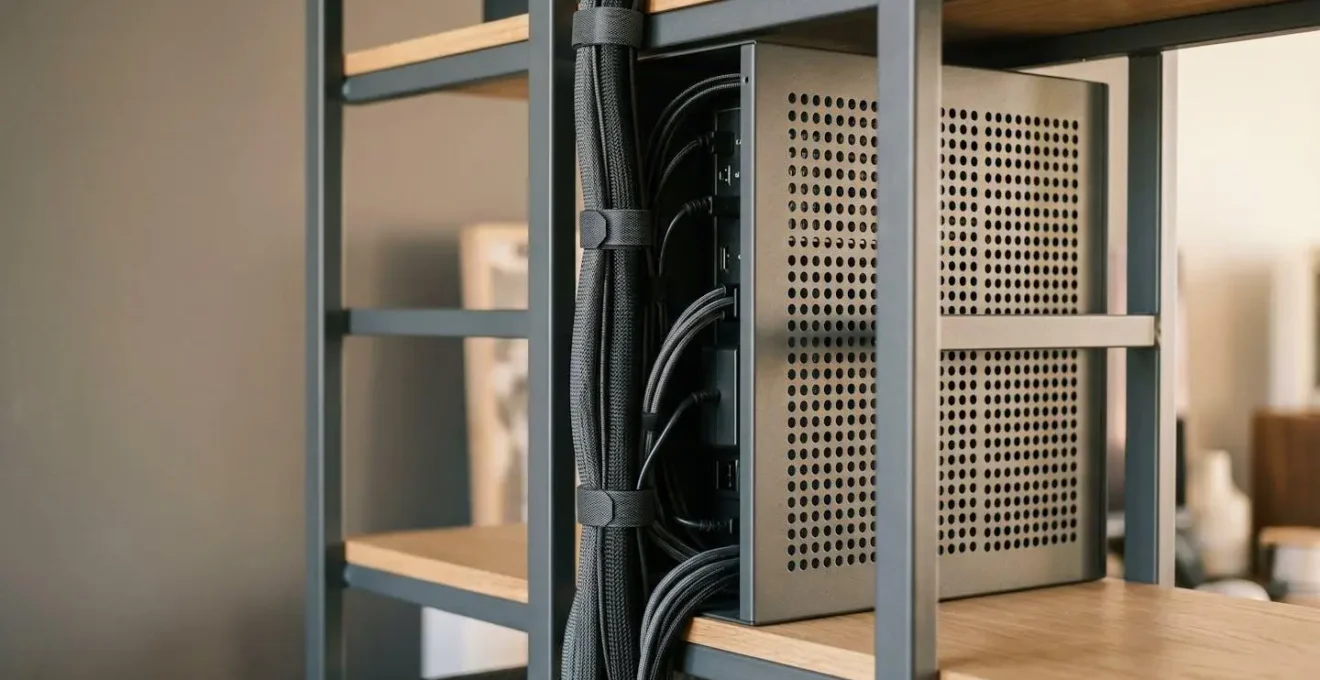
The goal is to create a clean, intentional look where technology is present and functional but not visually dominant. As the image above illustrates, a thoughtfully designed system provides dedicated pathways and compartments. Wires are grouped in fabric sleeves, run through integrated channels, and lead to a hidden hub. This approach transforms a potential eyesore into an elegant, invisible infrastructure, maintaining the clean lines and curated feel of the display.
This level of integration is what separates a mere collection of shelves from a true piece of personal infrastructure. It acknowledges that in the 21st century, managing our digital lives is as important as storing our physical possessions.
Which Opens Up Narrow Hallways Better Between Floating Shelves and Traditional Bookcases?
Narrow hallways are a common challenge in UK flats, often becoming little more than dim corridors. The conventional wisdom for adding storage here is to use floating shelves, as their lack of a floor footprint theoretically creates an illusion of space. While visually lighter, they have significant drawbacks for renters: they require extensive drilling, have limited weight capacity, and offer surprisingly little usable surface area. A traditional bookcase, on the other hand, is often too deep and bulky, constricting the walkway and making the space feel even more cramped.
This is where ultra-slim, freestanding modular systems present a superior third option. They bridge the gap by combining the stability and volume of a bookcase with a footprint that is often even smaller than a floating shelf’s depth. They are designed for maximum utility in minimal space. By standing independently, they require no installation, preserving your walls and your security deposit.
This approach offers the best of all worlds: significant storage capacity without the visual or physical bulk that closes in a narrow space.
Case Study: The Yamazaki Tower Collection for Compact Rentals
The Yamazaki Tower Collection is a prime example of design solving a renter’s problem. Requiring no installation or wall mounting, its pieces are ideal for those with strict lease agreements. Each item stands independently on a stable, compact base, eliminating property damage concerns. The collection’s lightweight steel design allows for easy transport during moves, and its small footprint (most pieces are under 12 inches/30cm wide) makes it perfect for tight apartment spaces like narrow hallways, providing vertical storage without impeding traffic flow.
Ultimately, while floating shelves create a *visual* illusion of openness, a slim modular unit creates *actual* functional space. It provides a home for keys, mail, shoes, and books without eating into the essential walkway, thereby opening up the hallway by making it more organized and useful, not just visually empty.
Which Hides Better in a Mid-Century Lounge Between Ergonomic Stools and Posture Cushions?
Integrating a workspace into a living area without compromising its aesthetic—especially a carefully curated one like a Mid-Century lounge—is a significant design challenge. When it comes to ergonomic seating, the choice often boils down to an ergonomic stool or a simple posture cushion. From a design integration perspective, the difference is profound. A posture cushion is an *admission of failure*; it is an additive element that signals your beautiful Eames-style lounge chair is, in fact, uncomfortable for long periods. It clutters the clean lines and disrupts the visual harmony.
An ergonomic stool, if chosen correctly, can be a piece of dual-function sculpture. The key is to select a stool that doesn’t scream « office. » Many modern designs are minimalist, crafted from materials like bent plywood or moulded plastic that complement Mid-Century aesthetics. They are designed to be beautiful objects in their own right. When not in use for work, a well-chosen stool can slide under a console table, act as a small side table for a drink, or function as an ottoman. It integrates, rather than disrupts.
The posture cushion is a temporary, unsightly fix. The ergonomic stool is a permanent, elegant solution. One is a patch, the other is part of the system. In a high-end living room, the goal is always seamlessness. The stool « hides » better because it can transform its function and belong in the space aesthetically, whereas the cushion can only ever be a foreign object placed on top of your existing design.
Therefore, for anyone looking to maintain a cohesive look, investing in an ergonomic stool that doubles as a stylish accent piece is the far superior strategy. It respects the design integrity of the room while providing the necessary support for temporary work sessions.
Key Takeaways
- View modular systems as a portable financial asset that moves with you, not a sunk cost left behind in a rental.
- Prioritise systems over standalone pieces to conquer the awkward layouts and « dead zones » common in period properties.
- Material quality is non-negotiable; cheap particleboard is a false economy for heavy loads like books and will inevitably fail.
How to Integrate Workspace Ergonomics Seamlessly Into High-End Living Room Designs
The modern home is no longer partitioned into single-use zones. The living room is also the office, the gym, and the cinema. For the nomadic professional, the challenge is to accommodate these functions without letting the living room descend into chaos. The secret, as many designers know, is the strategic deployment of modular storage. It is the ultimate tool for creating a multi-functional space that feels calm, organized, and intentional.
A truly adaptable system allows for what I call « functional fluidity. » This means creating zones that can appear when needed and disappear when not in use. A section of a modular wall unit can feature a drop-down desk surface. When the workday is over, the desk folds up, hiding the laptop and paperwork, and the unit reverts to being a simple, elegant bookcase. This isn’t just about hiding clutter; it’s about shifting the room’s primary purpose with a single, simple action.
This approach allows you to maintain the integrity of your high-end living space. Modular systems provide the framework for this fluidity, offering components that can be reconfigured as your needs evolve—from a home office setup to extra shelving for a growing family. As noted by organization expert Tom Clark, this flexibility is a powerful tool for modern living.
Modular storage systems offer the perfect solution, combining functionality with flexibility to transform any room while maximizing every square foot. They’re the secret weapon of interior designers and organization experts who understand that modern living demands furniture that works as hard as you do.
– Tom Clark, Storage & Organization Expert, 7 Best Modular Storage Systems for Flexible Living
By investing in a system rather than a collection of disparate items, you are creating a cohesive design language that can expand, contract, and evolve with your life. It ensures that your home, no matter its size or layout, remains a sanctuary first and a workspace second.
Your journey to a future-proofed rental life begins with a change in mindset. Start today by auditing your own living space. Identify the « dead zones, » the sagging shelves, the tangled wires. Then, consider which single, high-quality modular piece could be the first building block of your new, adaptable personal infrastructure.